

Specifications
Broker
Aircraft Details
• Located in Auckland, North Island, New Zealand
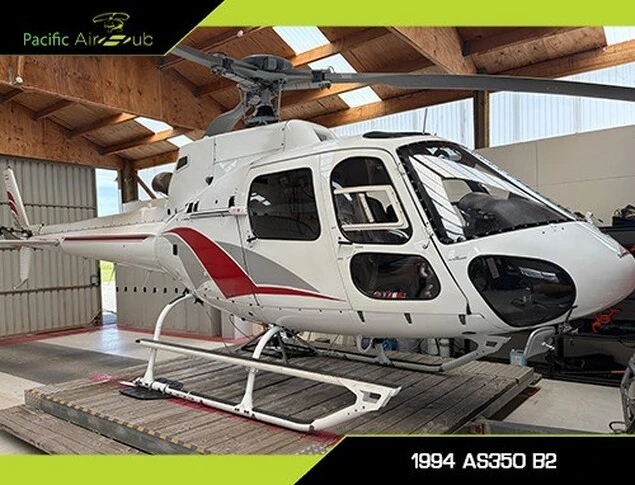
• Used condition, passenger/utility configuration
• Airframe total time: 12,689 hours
• Engine: Arriel 1D1 with various module times remaining (Module 1: 15YR due Oct 2038, Module 2: 824 hrs, Module 3: 969 hrs/15YR due Aug 2033, Module 4: 6,719 hrs, Module 5: 3,119 hrs)
• Component times remaining: MGB Epicyclic 3,648 hrs, MRB 6,771 hrs, TRB 659 hrs, TGB 199 hrs, Starflex 2,137 hrs
• 12-year inspection due June 2026 (with extension)
• Avionics: Garmin GMA345, Bendix King KX165A Nav Com, Bendix King KY196A VHF Com, Garmin GTX335 Transponder, Artex ME406HM ELT
• Equipment: Dual front seat, FDC Aerofilter, Bear Paws, Dart full length steps, Dart skid tubes, USB port
• Exterior: White with red/grey accents
• Interior: Grey leather
About this Model
Overview
The Airbus AS350B2 (often referred to as the AStar B2) is a single-turbine light helicopter commonly used for utility, passenger transport, and aerial work. It is known for strong power margins in hot-and-high environments, straightforward single-engine operating concepts, and a large, flexible cabin/cargo area relative to its class. Typical missions include short-to-medium legs with frequent landings where rapid turnaround and multi-role capability matter more than long-range cruise efficiency.
Mission Fit
The AS350B2 fits operators who need a robust, general-purpose platform that can switch between passenger, utility, and specialized roles with mission kits. It is typically most effective on regional missions with variable landing sites and payload requirements, including performance-sensitive high-density-altitude days.
Cabin
Cabin layout is mission-driven: it can be configured for passenger seating, mixed passenger/cargo, or utility-focused interiors. The cabin and wide access points support loading of gear and work equipment, while ride comfort and noise levels depend heavily on interior fit, soundproofing options, and installed equipment (e.g., baskets, racks, mission avionics).