

Specifications
Broker
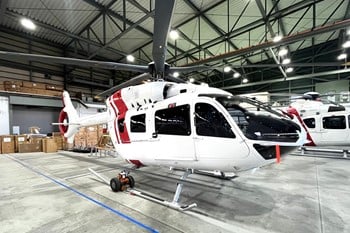
Aircraft Details
- FAA & EASA Certified
- Single/Dual Pilot IFR capability
- Air Conditioning system
- Inlet Barrier Filter installed
- Fixed provisions for External Hoist, Snow skid, Emergency Floats, and Wire strike
- EMS provisions available
- Warranty: 2 years or 1000 hours for aircraft; 3 years or 2000 hours for engines
- Engine type: Safran Arriel 2E
- Basic instrumentation includes Flight Display Subsystem with multifunction displays
- Vehicle Management System (VMS) with multiple sensors and monitoring systems
- Dual GTN 750Xi GPS/NAV/COM for pilot and copilot
- Digital Voice Control System (DVCS 6500)
- Transponder Lynx NGT9000R+ with ADS-B capabilities
- Optional equipment includes smoked windows, sun visors, and various fixed provisions for emergency equipment
- Interior configuration accommodates 8 passengers with EMS provisions
About this Model
Overview
The Airbus H145 D3 is the five-blade evolution of the H145 family, positioned as a light twin for operators who need a small footprint but want strong lift margins, modern avionics, and flexible interiors. The additional rotor blade primarily targets improved useful load and reduced vibration without materially increasing overall size, making it a fit for mixed missions that alternate between passenger transport and equipment-heavy work.
Mission Fit
In typical use the H145 D3 is selected for multi-stop days, confined-area operations, and missions that benefit from strong hover performance and quick reconfiguration. It is commonly configured to swap between passenger seating, medical interiors, and utility layouts with minimal downtime, supporting operators who value one airframe across multiple roles.
Cabin
Cabin experience is driven by mission configuration: the airframe supports practical access for loading and patient handling, with a flat-floor style utility cabin and wide openings that help crews work efficiently. Compared with earlier variants, the five-blade system is generally associated with lower perceived vibration, which can improve comfort for passengers and reduce fatigue on longer duty days.