

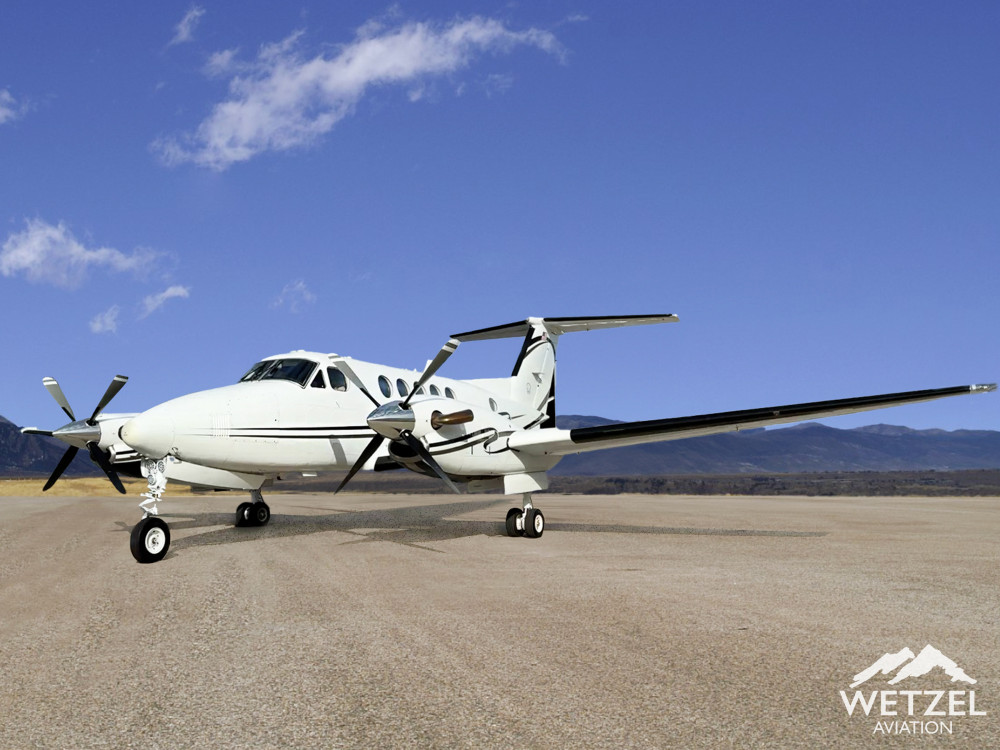
Specifications
Aircraft Details
- Engines: Pratt & Whitney PT6A-41; Left engine: 843 hours since overhaul, Right engine: 2,706 hours since new.
- Props: Raisbeck/Hartzell 4-blade; Both props: 418 hours since new; Overhaul completed March 2023.
- Avionics: Garmin G1000; Dual Garmin GDU 1040A (PFD), GDU 1500 (MFD), GCU 477 (FMS Controller), GMC 710 (Autopilot), GDC 74B (ADC), GRS 77 (AHRS), GMU 44 (Magnetometer), GIA 63W (IAU) WAAS, GWX 70 (WX Radar), GTX 3000 Mode S Diversity Transponder, GMA 1347D (Audio Panel).
- Additional Equipment: Raisbeck Ram Air Recovery System, Dual Aft Body Strakes, LED Taxi and Landing Lights, Blackhawk Torque and Fuel Flow Transducers, Cleveland Wheels & Brakes.
- Interior: Open cabin/slick cockpit; Grey sheepskin; Utility coin-style flooring; Forward cabin divider.
- Exterior: White base paint with black and platinum stripes; Last painted December 2005.
- Passenger Capacity: 8.
- Configuration: Cargo.
About this Model
Overview
The Beechcraft King Air 200 is a pressurized, twin-engine turboprop designed around reliable regional travel with the ability to use shorter runways than many light jets. It is commonly selected for mixed missions—business transport, government, medical, and special-mission roles—because it combines a practical operating footprint with a cabin that can be configured for passengers, equipment, or quick-change layouts depending on installation.
Mission Fit
The 200 series is well suited to point-to-point flying in the roughly 300–900 nm band, especially when the trip involves smaller airports or runway-length constraints. It is typically less compelling when the primary value driver is highest cruise speed, very high-altitude weather avoidance, or a large-cabin jet experience for longer legs.
Cabin
The King Air 200 cabin is a stand-up-in-the-aisle-for-some, pressurized turboprop cabin with club-style seating common in passenger configurations. It typically prioritizes practicality: good baggage access, large entry door, and a cabin that can be arranged for passengers, workstations, or mission equipment. Cabin noise and vibration are characteristic of turboprops and can vary significantly with interior refurbishment, insulation, and propeller/engine condition.