

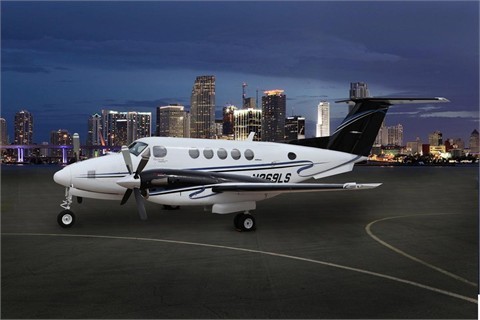
Specifications
Broker
Aircraft Details
- Maintenance: FAR Part 91; all inspections completed as of 05/21/2021.
- Useful Load: 4209 lbs.
- Damage History: Nose gear collapse on 06/28/2010; repaired by Hawker Beechcraft.
- Recent Maintenance:
- Right Engine Hot Section Inspection (02/01/2020)
- Prop Overhaul (08/01/2020)
- Airworthiness Directive compliance (10/20/2020)
- Phase 3 & 4 Inspections (03/01/2021)
- Left Engine Overhaul (05/01/2023)
- Engine Model: PT6A-41; TBO: 3600 hours.
- Avionics:
- Autopilot: Sperry SP-200
- Dual Garmin GTN-750 for communication and navigation
- Garmin G600 EFIS
- Garmin GTX-33ES Transponder
- Garmin GWX-70 Weather Radar
- Interior:
- Rating: 9; completed in 2009
- Configuration: Utility; seats 10
- Complete interior replacement with high-quality materials.
- Exterior:
- Rating: 8; completed in 2009
- Colors: JetGlo Matterhorn white, AcryGlo black, and Ming blue
- Chemically stripped and treated with epoxy chromate primer.
- Equipped with Raisbeck 4-blade props, ADS-B, and Terrain Awareness & Warning System.
About this Model
Overview
The Beechcraft King Air 200 is a pressurized, twin-engine turboprop designed around reliable regional travel with the ability to use shorter runways than many light jets. It is commonly selected for mixed missions—business transport, government, medical, and special-mission roles—because it combines a practical operating footprint with a cabin that can be configured for passengers, equipment, or quick-change layouts depending on installation.
Mission Fit
The 200 series is well suited to point-to-point flying in the roughly 300–900 nm band, especially when the trip involves smaller airports or runway-length constraints. It is typically less compelling when the primary value driver is highest cruise speed, very high-altitude weather avoidance, or a large-cabin jet experience for longer legs.
Cabin
The King Air 200 cabin is a stand-up-in-the-aisle-for-some, pressurized turboprop cabin with club-style seating common in passenger configurations. It typically prioritizes practicality: good baggage access, large entry door, and a cabin that can be arranged for passengers, workstations, or mission equipment. Cabin noise and vibration are characteristic of turboprops and can vary significantly with interior refurbishment, insulation, and propeller/engine condition.