

Specifications
Broker
Aircraft Details
- 11,881 hours and 15,363 landings since new (as of 4/19/26)
- Two Pratt & Whitney PT6A-60A engines (1,744 and 3,053 hours since overhaul)
- Raisbeck 4-blade swept Hartzell propellers, installed new 12/2022, overhauls due 12/2028
- Garmin G1000NXi integrated flight deck with GFC-700 autopilot, dual GDU 1050A NXi flight displays, GDU-1550 NXi MFD, dual Garmin NAV/COM/WAAS/LPV GPS, ADS-B, TCAS II, weather radar, synthetic vision, and more
- Executive interior: five main cabin seats with upgraded AVFAB headrests, two-place forward divan, aft belted lavatory seat, tan leather, beige closed loop carpet
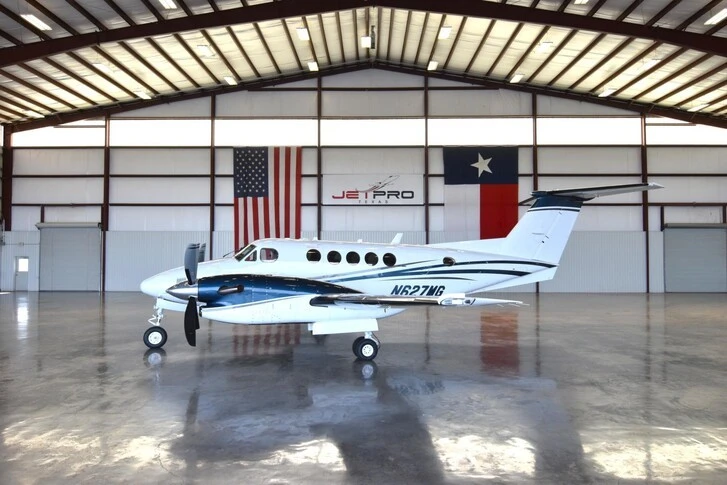
- Exterior: snow white with charcoal gray metallic and arctic blue metallic stripes, painted 2/2020 by Elliott Aviation
- Maintenance: Phase 1&2 due 10/31/2025 at 11,822 hours, Phase 3&4 due 10/25/2024 at 11,673 hours, landing gear overhaul due 10/2030
- Additional features: Luma Technologies integrated LED panels, LoPresti BoomBeam lights, Whelen LED tail/anti-collision lights, Mid-Continent standby instrument and lithium battery, 77 cubic ft. oxygen system, Butterfield oil and air/oil systems, propeller syncrophaser
About this Model
Overview
The Beechcraft King Air 300 series (commonly referring to the King Air 350/350i family in many listings) is a pressurized, twin‑engine turboprop built around reliable regional performance, a stand-up style cabin for its class, and strong access to shorter and more constrained runways compared with many jets. It is typically selected for owners and operators who prioritize dispatch reliability, mixed-use utility, and the ability to operate into smaller airports while carrying a practical passenger load.
Mission Fit
This model is generally used for multi-stop regional days where airport access and schedule resilience matter. Its strengths show up when the mission includes shorter runways, variable weather, and a need to carry people plus bags without depending on major hubs. If most trips are long, nonstop city pairs where cruise speed dominates total trip time, a light or midsize jet may fit better.
Cabin
The King Air 300-class cabin is designed around practical comfort: pressurization for typical turboprop cruise altitudes, club-style seating in many configurations, and good baggage flexibility for its size. Cabin noise and vibration are generally higher than in comparable business jets, though later interior packages and operator-installed sound treatments can improve perceived comfort. Entry is via an airstair door, and many aircraft are configured to support easy loading for business, family, or mission equipment.