

Specifications
Broker
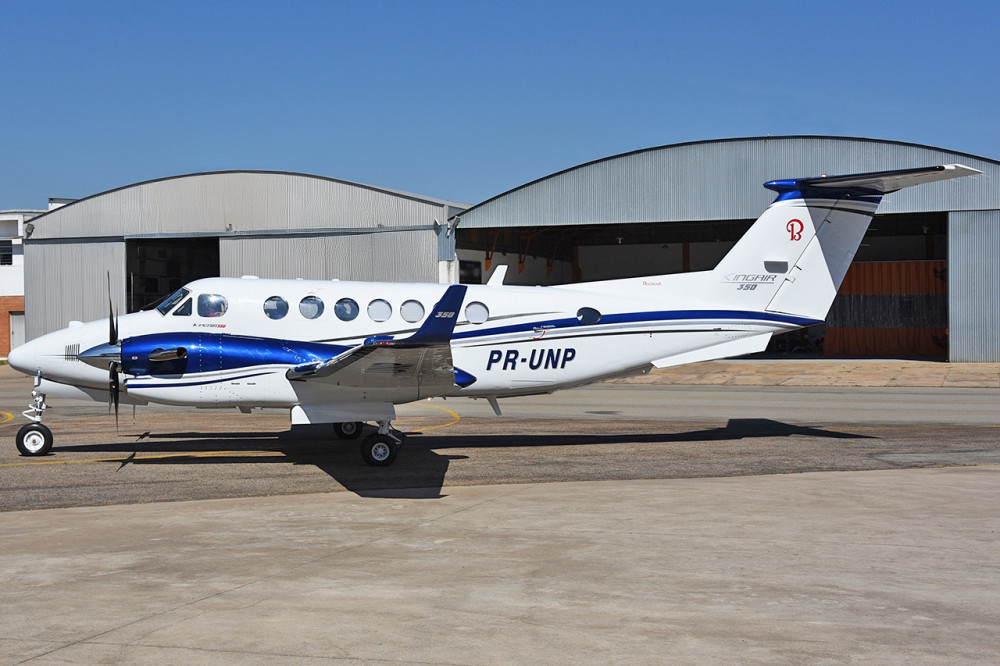
Aircraft Details
- Aircraft based and registered in Brazil.
- All maintenance current and airworthy.
- Equipped with Garmin GTN 725xi and GTN 625xi avionics.
- Executive interior configured for 9 passengers + 1 pilot.
- No accident or incident history; always kept in hangar.
- Airframe total time: 6,550 hours.
- Winglets equipped.
- Engines: Pratt & Whitney PT6A-60A, both with 6,550 hours since new and 650 hours remaining until TBO (3600 hours).
- Props: 6,550 hours since new.
- Avionics include Collins EFIS, Collins radios, autopilot, Bendix King radar, ADF, DME, RMI, ILS, terrain/GPWS, ELT 406, Stormscope, and FMS UNS-1 Universal.
- Interior features: Aft lavatory, standard oyster leather seating, dual aft jumpseats, tan carpeting, forward refreshment center, mid-cabin storage.
- Equipped with RVSM, ADS-B, brake de-ice, and terrain awareness systems.
- Exterior refurbishment completed in 2007.
About this Model
Overview
The Beechcraft King Air 350 is a pressurized, twin-engine turboprop frequently selected for missions that need airline-like dispatch reliability without requiring long paved runways or major-airport infrastructure. It balances cabin volume with strong climb performance and the ability to operate into smaller regional fields, making it a common choice for corporate, government, and special-mission roles.
Mission Fit
The 350 fits missions typically in the 300–900 nm range where the combination of pressurization, weather capability, and runway flexibility matters more than pure cruise speed. It can also support mixed passenger/baggage loads and frequent-cycle schedules, but buyers prioritizing maximum speed or a larger, stand-up cabin often look to light or midsize jets.
Cabin
The King Air 350 cabin is designed for practical comfort: a pressurized environment, relatively low cabin altitude for a turboprop class, and a layout that can be configured for business travel, utility transport, or specialized interiors. Noise and vibration are generally well-managed for the category, though the experience remains distinctly turboprop compared with a jet. Baggage is typically split between internal and external compartments depending on configuration.