

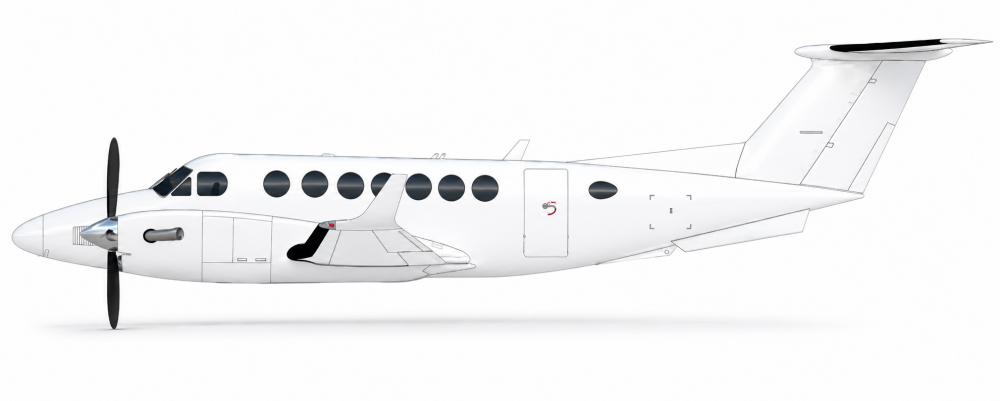
Specifications
Broker
Aircraft Details
• Fresh Phase 1-4 inspections completed
• Delivering with new strip & paint
• Light interior refurbishment with new carpet installed
• Engines (Pratt & Whitney Canada PT6A-60A) have over 1,500 hours remaining until overhaul
• Total airframe time: 7,082.6 hours; total landings: 6,175
• Maintenance tracking via CAMP; Certification Part 91
• Hartzell HC-B4MP-3C propellers
• Collins Pro Line 21 avionics suite with three EFIS displays, FMS-3000, GPS-4000S, TCAS II, and more
• High-speed Aircell Gogo Biz ATG 5000 broadband internet
• Eight passenger seats plus one belted lavatory seat
• Forward and aft four-place club seating configurations
• Aft lavatory with belted seat
• Propeller #1 and #2 overhaul due Jan. 2028 or 1,863.8 hours
• Landing gear overhaul due Aug. 2026
• ADS-B equipped, TAWS, TCAS, FMS, weather radar, and ELT as standard features
• One U.S. owner since new
• Extensive maintenance visit with conversion to OEM Ch. 5 standard intervals
About this Model
Overview
The King Air 350i is a long-running, pressurized twin-engine turboprop that prioritizes access and schedule reliability over jet cruise speeds. It is commonly selected where runway length, field elevation, weather, or infrastructure make turboprop capability practical, while still providing a stand-up cabin profile for most occupants, enclosed aft lavatory, and a professional flight deck suited to single- or two-pilot operations depending on mission and regulation.
Mission Fit
It fits best as a utility-forward business aircraft: fast enough for regional and cross-country legs with the advantage of turboprop climb and runway performance. Typical use cases include multi-stop days, service into secondary airports, and missions that benefit from robust short-field handling and predictable dispatch in varied weather. For buyers whose mission is primarily nonstop coast-to-coast at high cruise speeds, a light or midsize jet may align better.
Cabin
The 350i cabin is designed around comfort improvements relative to earlier variants, including a quieter interior package and refined materials. Seating is typically club-oriented with an aft area that can be configured for additional seats or storage, and an enclosed aft lavatory is common. Large windows and a flat floor contribute to a practical cabin for work and short-to-medium duration travel, with baggage carried in a sizable aft compartment that is often accessible in flight depending on configuration.