

Specifications
Broker
Aircraft Details
- Engines: Pratt & Whitney PT6A-20, 1,244 hours since overhaul for both engines.
- Propellers: Hartzell 3-blade props, recent repair due to bearing failure, overhauled prop governor.
- Avionics:
- S-TEC Systems 65 Autopilot & Flight Director
- Garmin GNS-430W & GTN-650W Comm/Nav/GPS
- BFGoodrich WX 500 Stormscope
- Sperry C-14 Compass
- King KGP-560 EGPWS
- BFGoodrich Skywatch SKY-497 TCAS
- Garmin GT33ES Transponder
- Bendix RDS-81 Color Weather Radar
- Interior: Executive six-passenger configuration, camel leather seating, four cabin chairs, side-facing bar seat, sheepskin inserts, Pecan ultraleather headliner, Glen Dronach leather sidewalls, bronze ribbon mahogany cabinetry, belted aft lavatory.
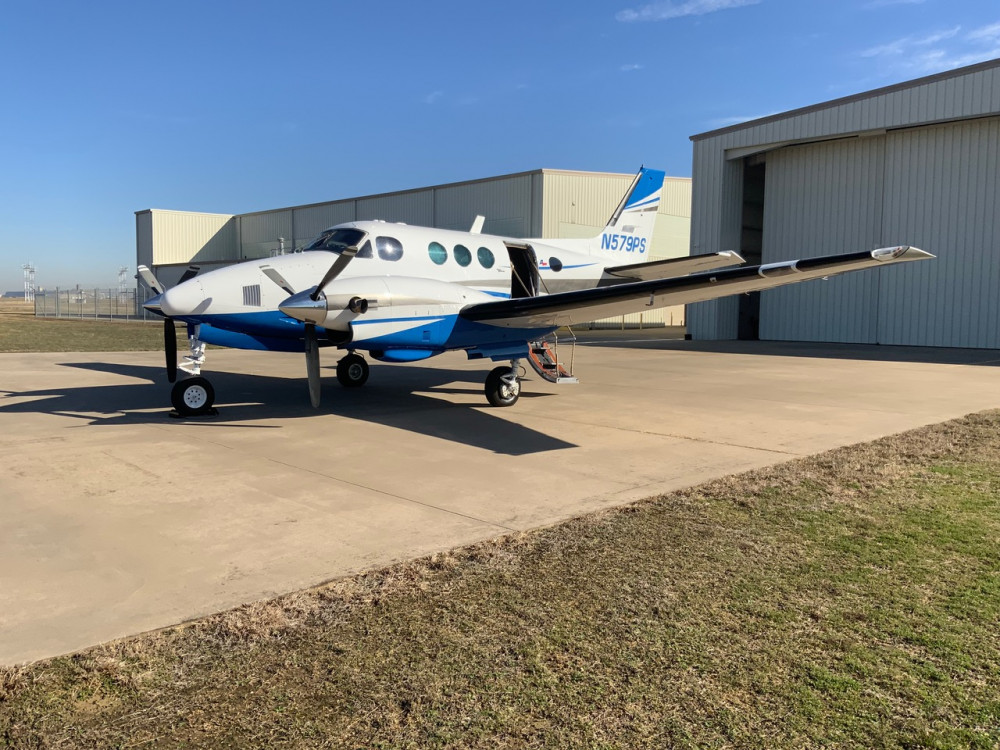
- Exterior: New paint as of November 2022, white upper fuselage, blue lower fuselage with blue and gray accents.
- Maintenance: Phase 1-4 inspections, 6-year landing gear inspection & overhaul, 3-year flap inspection, and other inspections currently underway (January 2026).
- Additional Features: ADS-B Out capability, LED landing lights, dual pitot/static systems, engine chip detectors, Cleveland brakes.
About this Model
Overview
The Beechcraft King Air B90 is an early, compact member of the King Air family designed for operators who want pressurization, twin-engine redundancy, and the ability to use shorter runways and regional airports. It is commonly used for business transport, owner-operator missions, and light utility roles where jet speeds are not required but predictable all-weather capability and payload flexibility matter. Compared with later King Air variants, the B90 emphasizes simplicity and lighter weight over cabin volume and long-range cruise.
Mission Fit
The B90 fits missions that prioritize airport access, moderate stage lengths, and operational flexibility over maximum cruise speed. Typical use cases include 200–500 nm sectors with comfortable pressurized cruise and the ability to stage from smaller fields. Payload-range planning is important when trying to combine full seats, baggage, and higher fuel loads.
Cabin
The cabin is pressurized and arranged to support small-group travel, typically in a club-style layout with an aft area used for additional seating or storage depending on configuration. As an older airframe design, interior fit, noise levels, and climate performance vary significantly with refurbishment quality and avionics/insulation upgrades. Boarding and baggage handling are generally straightforward for regional operations, but cabin volume is more limited than later King Air models.