

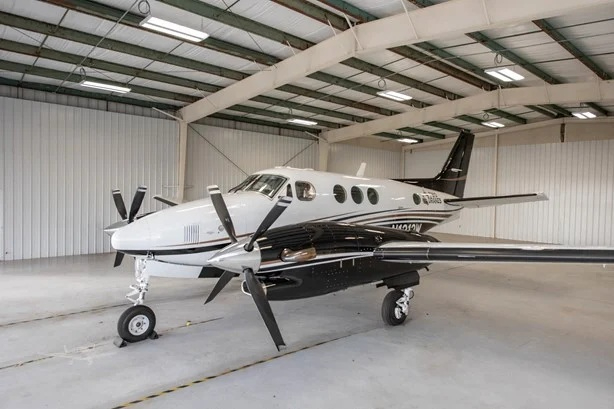
Specifications
Broker
Aircraft Details
- Based at KMCN, Macon, Georgia
- Total airframe time: 5,427 hours, 1,935 landings
- Blackhawk XP135A engine upgrade (2013), both engines 2,159 hours since new, 404 hours since hot section, TBO 3,600 hours
- Maintained under FAR Part 91, tracked in CAMP, serviced by Beechcraft Service Center
- Garmin G600 PFD, dual GTN750s, Collins Pro Line II avionics, Avidyne EX-500 MFD, ADS-B Out, XM weather
- Executive interior for 6 passengers, tan leather, new ultraleather headliner (2013), sand carpeting, electric flushing lavatory, Freon air conditioning
- Paint 8/10, interior 8/10, exterior in Beech C90Gtx scheme (white with black & platinum accents, done 2013)
- Raisbeck nacelle wing lockers, Parker Hannifan brake conversion, auto feather, prop synch, quick-release cabin door cable
- Equipped with traffic collision avoidance, cockpit voice recorder, emergency locator transmitter, and Honeywell TAWS
- 4 new fuel bladders, wing locker system installed
About this Model
Overview
The King Air C90B is a pressurized, twin‑engine turboprop positioned for operators who value runway flexibility, frequent-cycle reliability, and the ability to carry a small group plus baggage into a wide variety of airports. It sits below larger King Air 200/300-series aircraft in cabin size and payload/range capability, but typically offers lower complexity and strong suitability for regional schedules, owner-operation (where appropriate), and mixed passenger/cargo use.
Mission Fit
The C90B tends to fit best where stage lengths are moderate and the destination set includes smaller airports. It is commonly chosen for day-trip regional patterns, multi-stop itineraries, and missions that benefit from turboprop climb performance and runway performance rather than maximum cruise speed.
Cabin
Cabin comfort is oriented around a practical, club-style layout in a compact, pressurized fuselage. Expect a functional aisle and seating suitable for small teams rather than a large-cabin environment. Noise and vibration are typical of turboprops and vary with propeller setup, soundproofing condition, and interior refurbishment level. Baggage is generally accommodated in aft/side compartments depending on configuration, with tradeoffs between seating count and baggage volume.