

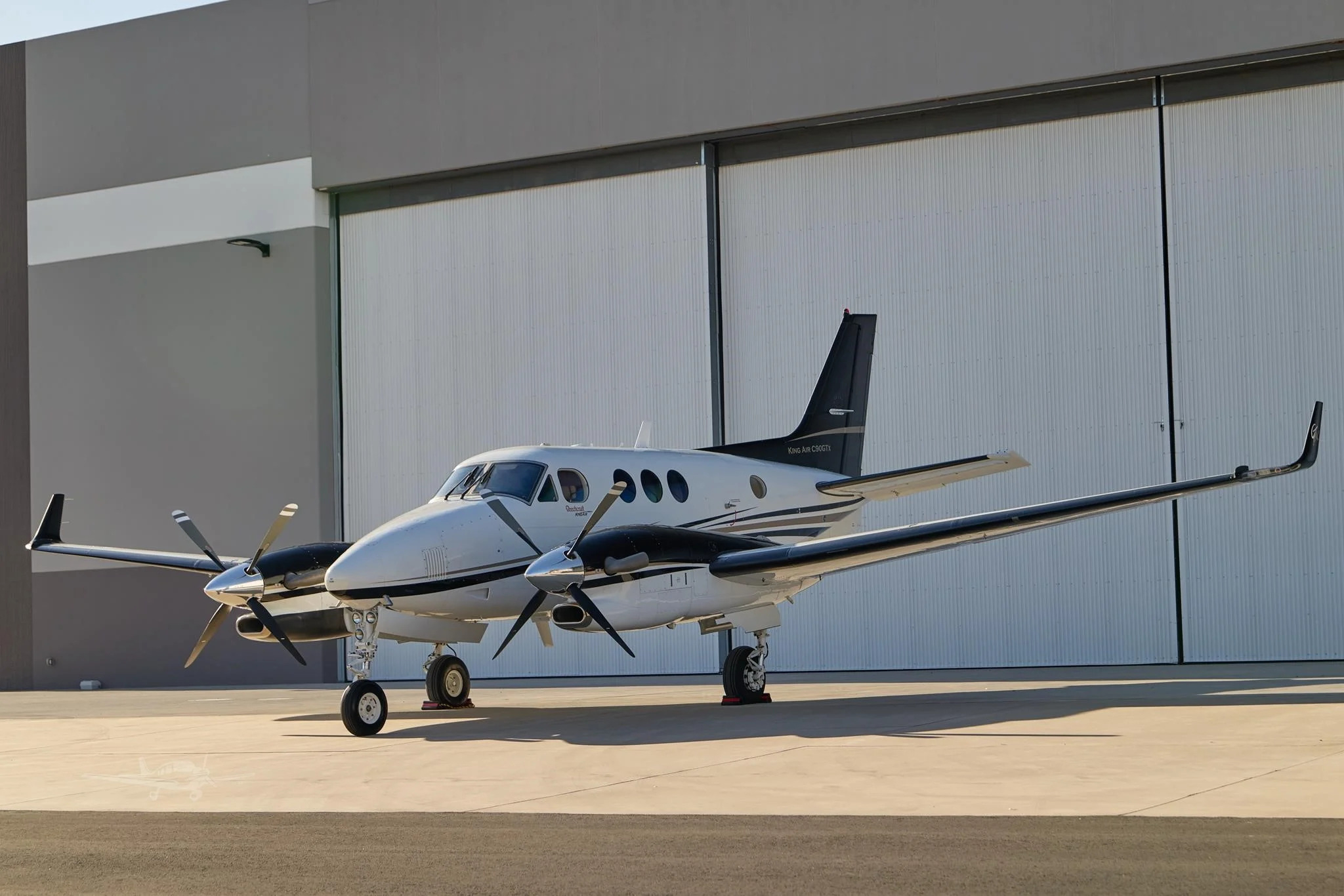
Specifications
Aircraft Details
- One owner since new, professionally managed and flown
- Maintained under FAR Part 91, on CAMP computerized maintenance tracking
- Pratt & Whitney PT6A-135A engines, 1,660 hours since new, 3,600-hour TBO
- 0 hours since right engine hot section inspection (HSI)
- Hartzell 4-blade propellers, both freshly overhauled
- Collins Pro Line 21 avionics suite with FMS-3000, GPS-4000A WAAS, IFIS, and three-tube EFIS
- Equipped with ADS-B Out, Class A TAWS, TCAS I, XM Weather, dual VHF-4000, dual NAV, dual Mode S transponders
- Additional: BLR winglets, Raisbeck nacelle wing lockers, 66 cubic foot oxygen system, 10,485 lb MGTOW mod
- Interior: Executive configuration, birch leather, bronze ribbon mahogany cabinetry, toffee freize carpet, sailcloth ultratech headliner, cameo allure fabric
- Exterior: Matterhorn white with black and platinum metallic stripes, original paint
- Phase 1 & 2 inspections due August 2025, Phase 3 & 4 and landing gear inspection completed January 2024
- No known damage history
- Extremely clean interior and excellent paint
About this Model
Overview
The King Air C90GTx is a modernized, small-cabin member of the King Air family aimed at operators who want pressurized turboprop capability without stepping up to larger airframes. It prioritizes runway flexibility, straightforward systems, and proven PT6A propulsion, making it a common fit for regional business travel, owner-operation, and light commercial roles where airports are constrained or schedules involve multiple short sectors.
Mission Fit
In typical use the C90GTx supports efficient regional stage lengths, particularly where the ability to access smaller airports saves surface travel time. It is less suited to long nonstop legs with high payload, or missions where stand-up cabin comfort is a priority.
Cabin
The cabin is a compact, pressurized executive layout intended for a small group. Seating is typically arranged in a club configuration, with a practical aisle and limited ability to move around in flight compared with larger turboprops and light jets. Noise levels and ride quality are consistent with a pressurized turboprop; passenger experience improves notably with well-maintained cabin seals, interior soundproofing, and properly rigged door/pressurization components. Baggage capacity is adequate for regional travel but can be limiting when all seats are occupied with larger luggage.