

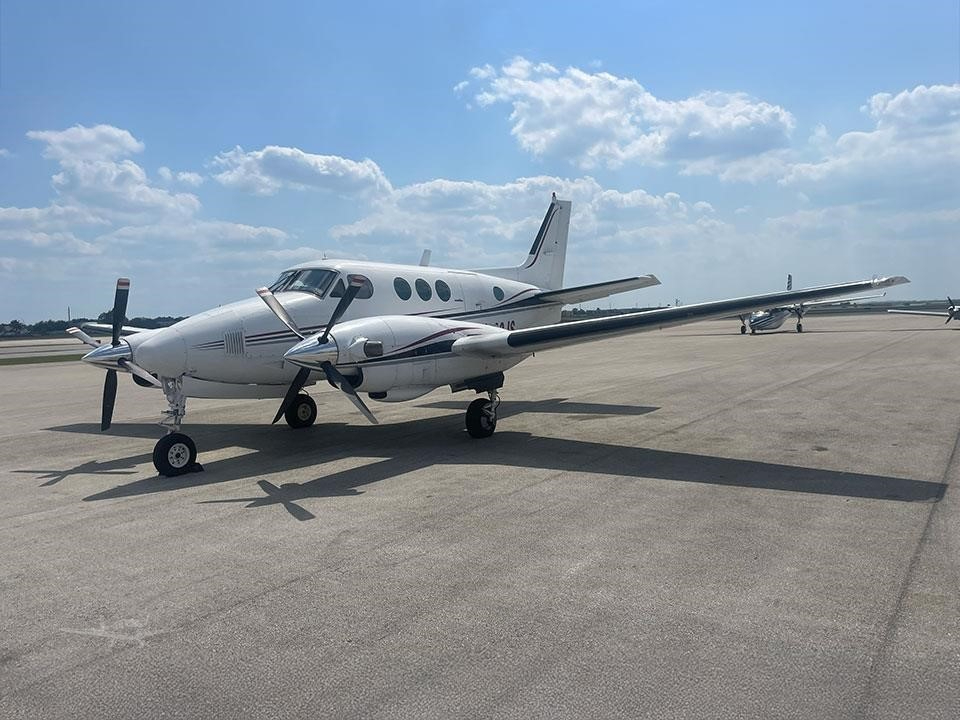
Specifications
Broker
Aircraft Details
- Engines: 2 x Pratt & Whitney PT6A-28
- Engine 1: 7,619 hours since major overhaul (SMOH), TBO 8,000 hours
- Engine 2: 80.6 hours SMOH, TBO 8,000 hours
- Props: McCauley 4-bladed props, overhauled July 2020
- Avionics:
- Flight Director: King
- Autopilot: S-TEC System 65
- GPS: Garmin GNS-430W
- Transponders: Garmin GTX-345W (ADS-B In/Out), Bendix/King
- Weather Radar: Bendix RDS-81A
- Interior:
- Seating: 6 passengers (+2 crew)
- Configuration: Executive with forward refreshment center and aft lavatory
- Material: Tan leather with dark laminate cabinetry
- Exterior: Overall white with blue and gray stripes
- Additional Equipment:
- Raisbeck dual aft body strakes and wing lockers
- Cleveland nose wheel
- Whelen tail light and rotating beacon
- Lead acid battery
- Maintenance: Maintained under FAR Part 135, with various inspections and overhauls completed recently.
About this Model
Overview
The King Air E90 is an early, smaller-cabin member of the King Air family, combining a pressurized cabin, twin-engine redundancy, and strong short/rough-field flexibility relative to many light jets. It is commonly selected for owner-operation, corporate regional travel, and utility roles where runway access and operating simplicity matter more than maximum cruise speed or stand-up cabin volume.
Mission Fit
The E90 typically fits missions where stage lengths are short to mid-range and the ability to use smaller airports improves door-to-door travel time. It is often used for multi-stop days and for destinations with limited ground support. If your typical trip profile is longer nonstop legs at higher true airspeeds, later King Air variants or light jets may align better.
Cabin
The cabin is pressurized and generally arranged for a small group, with club-style seating common, a center aisle, and a separate baggage area depending on configuration. Compared with larger King Air models, the E90’s cabin cross-section is smaller, and the overall cabin length typically supports fewer passengers and less room to move about in flight. Noise and vibration levels are typical of an older-generation turboprop; interior and insulation upgrades vary widely by aircraft.