

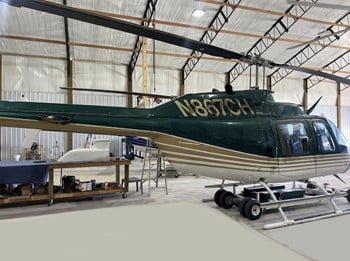
Specifications
Broker
Aircraft Details
- Model: Bell 206B III JetRanger, converted from 206B II.
- Airframe: 3,329 hours since conversion in 1996; no damage history.
- Engine: Rolls Royce 250-C20B; 13,946 total hours since new; 1,321 hours remaining on compressor; 3,500 hours remaining on turbine.
- Avionics: ADS-B equipped; includes King KY 196 VHF Comm, KX 155 Nav/Comm, KLN 88 GPS, KT 76A Transponder, and KI 208 VOR-LOC Indicator.
- Modifications: Vibration Reduction System (VRS), high skids, range extender, bleed air heater, wire strike kit, particle separator, wedge windows, dual controls, rotor brake.
- Additional Equipment: 5-place ICS intercom system, dual shoulder straps for pilot/copilot, baggage compartment, sliding windows, automatic door openers.
- Interior: Tan leather seats in a 2+3 configuration with matching carpet.
- Exterior: White base with green and gold accents.
- Inspection: Fresh main transmission overhaul, new TT straps (36 months).
About this Model
Overview
The Bell 206B III JetRanger is a widely used light single-engine turbine helicopter known for straightforward systems, predictable handling, and broad mission versatility. It is commonly selected for local passenger moves, pilot training, patrol, and light utility roles where ramp footprint, ease of operation, and turbine reliability are prioritized over payload and all-weather capability.
Mission Fit
Best suited to missions that stay relatively close to base and emphasize dispatch simplicity. The aircraft’s utility is strong for local flying, but payload/range margins narrow quickly with multiple occupants, fuel, and high-density-altitude conditions.
Cabin
The JetRanger’s cabin is compact and functional, typically arranged for a pilot plus four passengers, with good outward visibility that supports sightseeing and observation tasks. Noise and vibration levels are typical for a legacy light turbine helicopter; passenger comfort is highly dependent on interior condition, seating, and headset/intercom quality.