

Specifications
Broker
Jet Aviation Brokers
John Carter
+1 (305) 555-0142
Aircraft Details
- Condition: Used
- Good times remaining
- New TT straps
- FDC Aerofilter inlet barrier filter
- Van Horn main and tail rotor blades
- Air Comm bleed air heater
- Facet Purolator external oil filter
- Radar altimeter
- Wedge windows
- Dual caliper rotor brake kit
- Airframe:
- Van Horn main rotor blades: 13,284 hours remaining
- MR hub: 2,360 hours remaining
- MR transmission: 506 hours remaining
- Tail rotor gearbox: 4,010 hours remaining
- Van Horn tail rotor blades: 3,754 hours remaining
- Engine: Rolls Royce 250-C30P
- Compressor inspection: 837 hours remaining
- Impeller: 4,880 hours remaining
- Turbine: 837 hours remaining
- Wheel 1 & 2: 862 hours / 1,262 cycles remaining
- Wheel 3 & 4: 3,387 hours / 4,262 cycles remaining
- Gearbox: On condition; 3,172 (TSI) hours since inspection
- Avionics:
- ADS-B equipped
- Garmin GNC420 GPS/COMM
- King KY196A VHF COMM
- Traffic avoidance system
- Interior: 1+6 seats, standard cabin configuration with individual seat belts and shoulder harnesses.
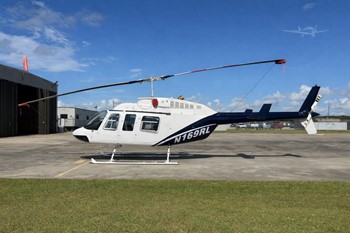
- Exterior: White and dark blue.
About this Model
Overview
The Bell 206L-4 LongRanger is a stretched, single-engine turbine helicopter in the 206 family, commonly selected for utility, passenger transport, patrol, and aerial work where simplicity and established support infrastructure matter. Compared with earlier LongRanger variants, the L-4 is typically associated with higher allowable gross weight, which can translate into more payload or fuel flexibility for the same mission profile. It is a conventional, two-blade rotor design that prioritizes predictable handling and straightforward day-to-day operation over high-speed performance.
Mission Fit
The LongRanger is most at home on missions that value versatility: moving small teams and equipment, running frequent shuttles, or supporting aerial work with the right optional equipment. It is less aligned with use cases that depend on twin-engine dispatch expectations or unusually demanding hot/high performance, where payload restrictions can become limiting.
Cabin
The elongated cabin provides more passenger and baggage flexibility than short-cabin 206 variants, supporting practical seating for multiple occupants and gear with good all-around visibility—useful for both passenger transport and observation-oriented work. Comfort and noise/vibration characteristics depend heavily on interior completion, soundproofing, and mission equipment; many aircraft are configured to match specific roles rather than a uniform executive standard.