

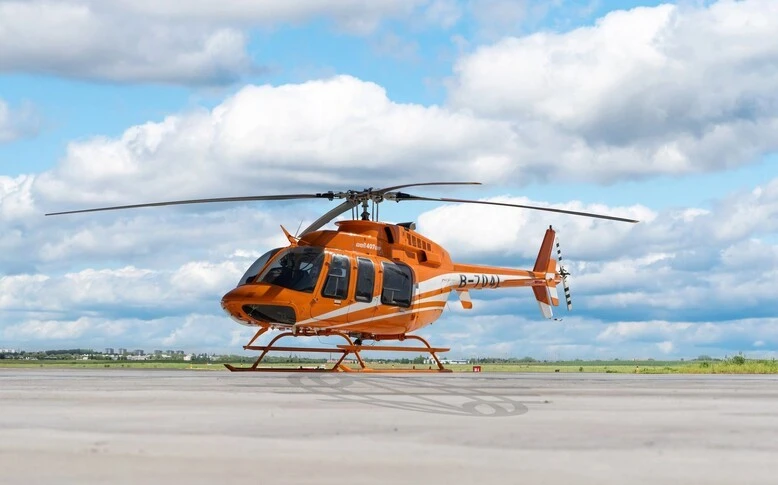
Specifications
Broker
Aircraft Details
- Aircraft Model: BELL 407GXP
- Engine: Rolls-Royce RR250-C47B/8
- Engine TBO: 2,000 hours
- Max Fuel Capacity: 128 gallons (483 liters)
- Max Payload: 1,142 lbs (518 kg)
- Max Takeoff Weight: 5,250 lbs (2,381 kg)
- Basic Operating Weight: 3,000 lbs (1,360 kg)
- Max Landing Weight: 5,250 lbs (2,381 kg)
- Normal Speed: 121 knots
- Long-Range Cruise Speed: 138 knots
- Maximum Cruise Speed: 153 knots
- Service Ceiling: 20,000 feet
- Climb Performance: 7,089 feet per minute
- Range (Long-Range Cruise, 4 Pax): 300 nautical miles
- Ferry Range (2 Crew + Full Tanks): 337 nautical miles
- Seating Capacity: 5 passengers
- Interior Configuration: 3 forward-facing seats, 2 aft-facing seats
- Exterior Color: Orange with white accents
- Interior Colors: Blue, Grey & Beige
- Inspection Status: Next due 150 HR / 12 M by September 2025, 300 HR / 12 M by September 2025
- Additional Features: Wire Strike Kit, ADS-B Out, Rotor Brake, Inlet Barrier Filter, Cabin Heater, Chin Bubble Defog, Auxiliary Fuel Tank & Cargo Hook Provisions.
About this Model
Overview
The Bell 407GXP is a development of the 407 line that pairs the proven four-blade rotor system and spacious cabin format with an upgraded Rolls‑Royce 250‑C47B engine. It is typically chosen for operators who want a straightforward, widely supported single-engine platform for passenger, utility, and aerial work where quick turn capability, hot/high margin, and external-load flexibility matter more than long-range cruise.
Mission Fit
In practice, the 407GXP fits missions that start and end within a regional operating area and value rapid start/stop cycles, good hover performance, and reconfigurable cabin utility. Its performance is often leveraged for hot-and-high or high gross weight scenarios compared with earlier 407 variants, but the aircraft remains a single-engine platform, which can shape routing, overwater/remote-area planning, and customer acceptance.
Cabin
The cabin is set up for practical loading and quick reconfiguration, typically supporting a pilot plus multiple passengers with wide access for boarding and gear. Noise and vibration levels are characteristic of a modern single-engine helicopter; comfort depends heavily on interior completion, seating, and mission equipment (e.g., partitions, medical interiors, or camera mounts).