

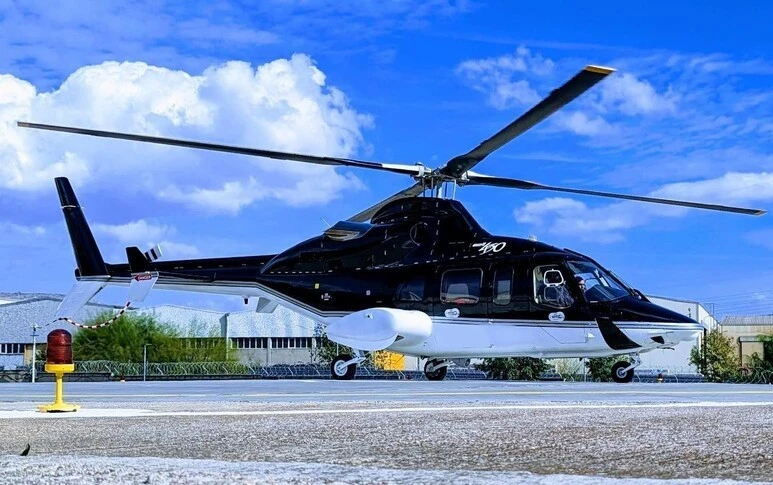
Specifications
Broker
Aircraft Details
- Fresh hot section inspection on both engines.
- Fresh 12/24M inspection completed.
- Immaculate condition, no known damage history.
- Airframe total time: 3,474 hours.
- Airframe total landings: 8,170 cycles.
- Engines: Rolls-Royce Corporation turbo-shaft, model 250-C40B.
- Engine total hours since new: Left engine 3,445:10, Right engine 3,430:04.
- Engine total cycles since new: Left engine 5,027, Right engine 5,026.
- Time between overhaul for engines: 3,500 hours.
- Last 12-month check performed on 10/10/2023.
- Avionics: MFD TFT/LCD, Quad GPS Garmin GNS 530, King radios (KRA-405B, KDM-706A, KDF-806, KTR-908).
- Navigation compliance: Day/Night VFR, Category A and B, non-icing conditions.
- Passenger capacity: 5 + 1 belted.
- Interior color scheme: Beige leather, light brown carpet.
- Exterior paint: New condition.
About this Model
Overview
The Bell 430 is a twin-engine derivative of the Bell 230/222 family, positioned for operators who want higher cruise speed and improved hot/high performance relative to earlier variants while keeping a relatively compact footprint for urban helipads. It is commonly used for corporate transport, offshore support, and public-service roles where two-engine redundancy and IFR avionics are preferred.
Mission Fit
Typical missions emphasize time-sensitive passenger transport and light payloads at relatively high cruise speeds for the class. The aircraft’s strengths show most on short-to-medium legs with frequent turns, where vertical access and twin-engine margins matter more than long-range endurance.
Cabin
The cabin is oriented toward corporate transport with club-style seating options and a flat floor relative to many helicopters in its size class, supporting easy passenger entry and a clean interior finish. Noise and vibration levels depend strongly on interior treatment and rotor/drive-train condition, so similarly equipped aircraft can feel different in service.