

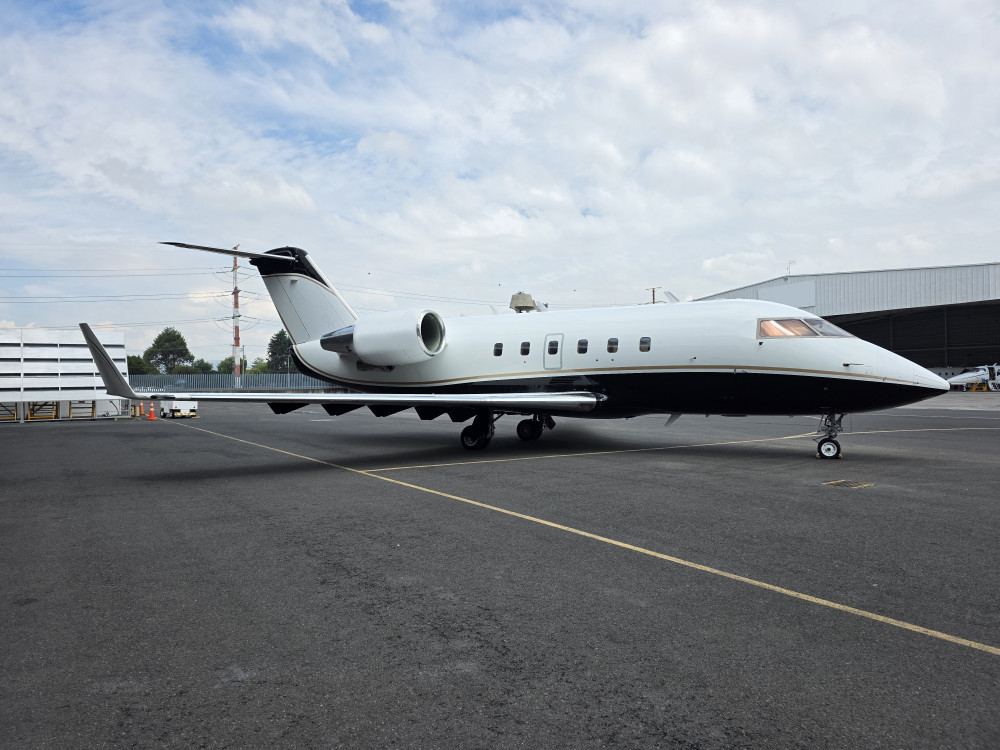
Specifications
AI Description
- Total Hours: 10,486
- Total Cycles: 6,699
- Engines:
- Engine 1: CF34-3A, 3,802 hours since new
- Engine 2: CF34-3A, 5,821 hours since new
- APU Total Time Since New: 9,427
- Avionics:
- Dual Collins ADF-60A
- Honeywell SPZ-600 IFCS Autopilot
- Honeywell SPZ-8000 IFCS/Pro Line II Avionics Package
- Triple Collins VHF-22C Communication Radios
- Dual Collins DME-42
- Honeywell Class A TAWS
- Collins TCAS-II
- Interior Configuration: Executive for 12 passengers
- Seating:
- Forward 4-place pecan leather club
- Aft 3-place cream ultrasuede fabric divan
- Teal leather dinette group
- Refreshment Equipment: Forward S-galley with microwave, convection oven, coffee maker, and espresso maker
- Entertainment: Airshow 4000, multiple LCD monitors, Wi-Fi
- Exterior Colors: Matterhorn White with gloss black and Las Vegas gold stripes
- Maintenance Tracking: CAMP
- Damage History: Hard landing in 1992, repaired by Bombardier.
About this Model
Overview
The Challenger 601-1A is an early-generation variant of Bombardier’s large-cabin Challenger family, positioned for buyers who want a wide-cabin platform with intercity and some long-range missions, but who are comfortable with older avionics architecture and legacy support considerations. Compared with later Challenger models, it emphasizes cabin volume and proven airframe design over modern flight deck integration and fuel efficiency.
Mission Fit
In typical use the 601-1A fits missions where cabin comfort and payload flexibility matter as much as cruise speed. It is most compelling on multi-hour legs where the cabin’s width supports a true executive seating environment and onboard service. It can be less compelling for buyers who need short-field flexibility or who want the operational simplicity of newer digital cockpits and current-production systems.
Cabin
The Challenger 601-1A’s defining attribute is its wide cabin cross-section, which supports a conventional double-club seating feel, a usable aisle, and space for cabinetry and refreshment centers depending on interior completion. Cabins vary meaningfully by serial number and refurbishment history, so comfort, noise levels, and onboard amenities often depend more on interior vintage than on the base model.