

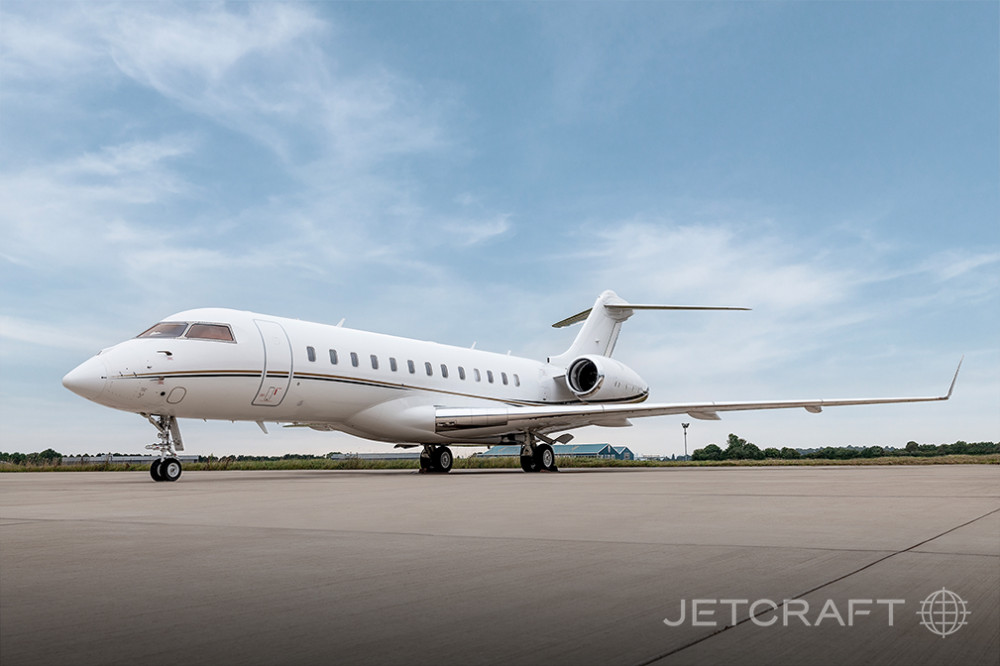
Specifications
Aircraft Details
- Passenger Capacity: 13 passengers
- Interior Configuration:
- Forward: 4-place club
- Mid Cabin: 4-place conference group opposite 1-place club
- Aft Cabin: 1-place club opposite a 3-place divan
- Galley Location: Forward
- Lavatory Locations: Forward & Aft
- Crew Rest Area: Yes
- Jumpseat: Yes
- Internet: Swift Broadband
- Engines: Rolls-Royce BR700-710A2-20
- Engine 1: 4,823 hours, 2,006 cycles
- Engine 2: 4,864 hours, 2,019 cycles
- APU: Honeywell RE220, 4,842 hours
- Maintenance Programs:
- Airframe: JSSI
- Engines: Rolls Royce CorporateCare
- Exterior Colors: Base - Snow White, Stripes - Gold & Black
- Compliance: CPDLC, FANS 1/A
- Inspection Status:
- 24-Month: Next due December 2026
- 60-Month: Next due September 2027
- 120-Month: Next due June 2032
- Damage Status: Wing struck runway during landing on June 22, 2023.
About this Model
Overview
The Global 6000 is positioned for operators who prioritize nonstop intercontinental capability, a stand-up cabin with multiple living zones, and a mature Bombardier support ecosystem. It sits in the large-cabin, long-range segment and is commonly used for corporate shuttle, executive travel, and high-utilization private operations that value consistent long-range performance and cabin comfort over short-field flexibility.
Mission Fit
Mission strength is long legs at high cruise speeds with enough cabin volume to keep passengers productive and rested. It is generally less compelling when missions are predominantly sub-2-hour sectors or when runway constraints are the primary driver.
Cabin
Cabin design emphasizes long-duration comfort: a full-height, wide cabin arranged into distinct zones for conferencing, dining, and rest. Typical layouts support in-flight productivity with a dedicated work area, followed by a lounge/dining section, and an aft rest space that can be configured for crew and/or passengers. Noise levels and pressurization are oriented toward reducing fatigue on long flights, and baggage access is designed for long-trip loads.