

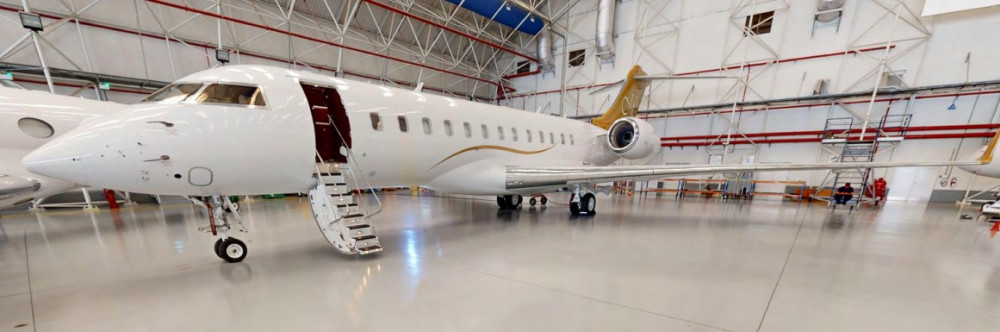
Specifications
Aircraft Details
- Very low time airframe
- Enrolled on CAMP maintenance tracking program
- Crew and cabin seats refurbished in 2020
- Engines: Rolls Royce BR700-710A2-20
- Left Engine: 1211.1 hours, 401 cycles
- Right Engine: 1211.1 hours, 401 cycles
- Auxiliary Power Unit: Allied Signal RE-220 (GX), 1388 hours
- Gross Weight: 99,750 lbs
- Max Takeoff Weight: 99,500 lbs
- Max Landing Weight: 78,600 lbs
- Max Zero Fuel Weight: 58,000 lbs
- Empty Weight: 50,593 lbs
- Avionics: Rockwell Collins Pro Line Fusion® with version 5.5.1
- Equipped with FANS, CPDLC, and EVS
- Interior configuration: 13 passengers, plus crew rest and jump seats
- Features: Forward galley, forward crew lavatory, aft full lavatory
- Entertainment: Airshow, HD monitors, dual Blu-ray players, Wi-Fi
- Exterior: Painted Matterhorn White with Global Gold tail, last painted in 2016
About this Model
Overview
The Global 6000 is positioned for operators who prioritize nonstop intercontinental capability, a stand-up cabin with multiple living zones, and a mature Bombardier support ecosystem. It sits in the large-cabin, long-range segment and is commonly used for corporate shuttle, executive travel, and high-utilization private operations that value consistent long-range performance and cabin comfort over short-field flexibility.
Mission Fit
Mission strength is long legs at high cruise speeds with enough cabin volume to keep passengers productive and rested. It is generally less compelling when missions are predominantly sub-2-hour sectors or when runway constraints are the primary driver.
Cabin
Cabin design emphasizes long-duration comfort: a full-height, wide cabin arranged into distinct zones for conferencing, dining, and rest. Typical layouts support in-flight productivity with a dedicated work area, followed by a lounge/dining section, and an aft rest space that can be configured for crew and/or passengers. Noise levels and pressurization are oriented toward reducing fatigue on long flights, and baggage access is designed for long-trip loads.