

Specifications
Aircraft Details
• 3,163.6 hours total time, 2,858 cycles
• Engines: 2x Honeywell TFE731-20AR-1B, 3,163.6 hours since new, TBO 5,000 hours
• Avionics: Honeywell Primus 1000 system, dual Universal UNS-1E FMS with GPS, dual Honeywell RNZ-851 nav units, dual RCZ-833K comm units (8.33 spacing), Honeywell Mark V EGPWS, TCAS-2000, KHF-950 HF radio, RT-300 radio altimeter, Mode S transponder, Primus 660 weather radar
• Additional equipment: ADS-B Out, WAAS, EICAS, dual Honeywell AZ-950 air data computers, dual DA-800 digital acquisition units, dual IC-600 autopilot computers, clearance delivery radio, Artex C406-2 MHz ELT, dual Davtron M850 chronometers, Airshow 410, 10.4” LCD monitor, cabin entertainment with 10-disc CD changer & DVD, 110 VAC outlets, external baggage, recognition pulse lights
• Interior: Executive 7-passenger configuration, light brown leather seats with accent welting, club seat, galley rest seat, cream Ultraleather headliner and sidewalls, gold/brown/beige speckled carpeting, forward galley with warming oven, medium dark straight-grain wood veneer, dual executive foldout tables, aft lavatory
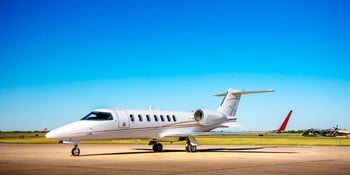
• Exterior: Matterhorn white with sunfast red and medium gold metallic accent stripes
• Inspection status: Phase A due 05/2026, Phase B due 3,500.6 hrs/05/2027, Phase C due 3,694.0 hrs/04/2027, Phase D due 4,894.0 hrs/04/2031
• Two owners since new, maintained under FAR Part 91, winglets equipped.
About this Model
Overview
The Learjet 40 is a light business jet positioned between entry-level light jets and larger midsize aircraft. It emphasizes relatively high cruise speeds for its class, a two-pilot cockpit, and a straightforward cabin sized for small groups on regional and some longer domestic legs. Typical use cases include point-to-point travel where access to shorter runways and higher cruise speeds matter more than stand-up cabin volume.
Mission Fit
In practical service, the Learjet 40 fits teams that travel with modest luggage and prefer quick stage lengths where climb and cruise speed deliver time savings. Mission planning should account for passenger count, baggage volume, and seasonal winds, which can push fuel stops on longer segments.
Cabin
The cabin is a classic light-jet layout: a forward refreshment area and an aft private lavatory, with club seating as the core configuration. Space is adequate for seated work and conversation, but it is not a stand-up cabin and feels most comfortable with smaller groups. Baggage capacity is generally suitable for briefcases and a few soft bags, with packing strategy becoming important as passenger count increases.