

Specifications
Aircraft Details
- Engines & APU: Enrolled on JSSI 100%, Pratt & Whitney PW305A engines, 7200 TBO, 2351.5 hours since new, 1524 cycles.
- APU: Hamilton Sundstrand T20G-103A, 986 hours, enrolled on JSSI.
- Avionics: Collins Pro Line 21, ADS-B equipped, dual Collins radios, GPS, FMS, TCAS, and weather radar.
- Interior: Executive configuration for 7 passengers, featuring a forward galley, fully-enclosed belted aft lavatory, and Airshow entertainment system.
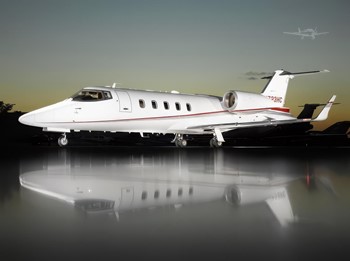
- Exterior: Matterhorn white with burgundy and silver stripes, winglets installed.
- Maintenance: FAR Part 135 compliant, CAMP maintenance tracking, no damage history, with scheduled inspections (A, B, C, D) noted.
- Additional Features: Gogo AVANCE L5 WiFi, LED landing and taxi lights, thrust reversers, and inlet cowling upgrade STC.
- Seating: 2-place divan, single forward-facing seat, and 4-place club seating arrangement.
About this Model
Overview
The Learjet 60XR is an updated version of the Learjet 60, retaining the type’s emphasis on cruise speed and climb performance while adding a more modern flight deck and cabin refinements. It is typically used for regional and mid-length business trips where time-to-climb, fast cruise, and access to shorter runways matter, with a cabin sized for comfortable seated productivity rather than stand-up movement.
Mission Fit
Typical missions favor two-to-three-hour legs with the ability to depart efficiently from a wider set of airports than some larger-cabin jets. It fits teams that prioritize schedule control and speed over maximum cabin volume, and it works well for mixed business travel where a midsize footprint is a constraint at certain ramps and hangars.
Cabin
Cabin comfort is oriented around a club-style seating environment with good forward visibility and a compact, functional galley area depending on configuration. The 60XR remains a low-slung Learjet cabin: well suited to seated work and conversation, but less conducive to moving around in-flight compared with larger-cabin midsize and super-midsize designs. Baggage is typically split between internal and external areas; buyers should confirm what is accessible in flight for their use case.