

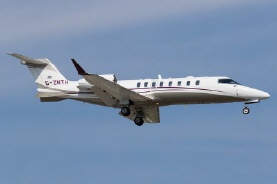
Specifications
Broker
Jet Aviation Brokers
John Carter
+1 (305) 555-0142
broker@example.com
Aircraft Details
- One owner since new
- Professionally operated
- Equipped with CVR/FDR and dual HF radios
- Engines: Honeywell TFE-731-40BR (both engines at 3,934 hours since new)
- Total landings: 2,890
- Engines enrolled on Honeywell MSP
- APU total hours: 1,413, on Honeywell MSP
- Swift WiFi connectivity
- Garmin 5000 avionics suite
- Executive seating for 8 + 1 in double club configuration
- Swift broadband and 6 personal monitors
- Side-facing belted lavatory with vanity sink and mirror
- Exterior: Matterhorn white with metallic antique silver and berry red stripes in a modern scheme
About this Model
Overview
The Learjet 75 is a late-generation Learjet family light jet designed around fast cruise, strong climb, and a conventional business-jet cabin for 6–8 passengers depending on layout. It is commonly selected by owner-operators and corporate flight departments that value time-to-climb and point-to-point utility within North America and similar regional networks, while keeping the footprint and operating complexity of a light jet.
Mission Fit
In typical use, the Learjet 75 fits 300–1,500 nm stage lengths with schedule-driven turns. It can cover longer legs under favorable conditions, but mission planning is more comfortable when reserves, alternate requirements, and passenger/baggage loads do not push the airplane to its limits. If your core mission is transcontinental with consistently high payload and comfort expectations, step-up categories generally fit better.
Cabin
The cabin is a classic light-jet environment: a club seating area with a compact forward galley/refreshment center and an aft lavatory. Seating and storage are adequate for business travel, but passenger movement is more constrained than in midsize cabins, and carry-on management matters when traveling with larger groups. Noise and ride quality are typical for the class, with the best experience achieved when the aircraft is operated at the high flight levels in cruise.