

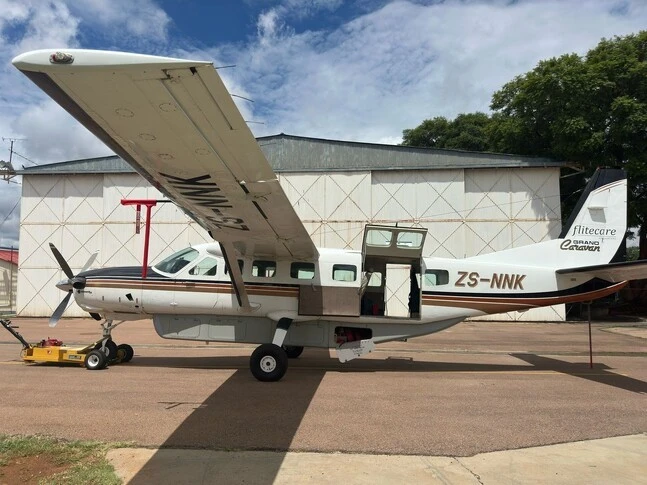
Specifications
Aircraft Details
- Single-turboprop-engine aircraft with robust design.
- High-winged structure for unobstructed aerial views.
- Spacious air-conditioned cabin.
- Generous luggage capacity.
- Suitable for operation from bush airstrips.
- Blackhawk XP42A engine upgrade.
- Time since new for engine: 1,373 hours.
- Time between overhaul for engine: 3,600 hours.
- Total airframe time: 5,074 hours.
- Total cycles: 6,022.
- Four-blade Hartzell propeller.
- Dual Garmin G600 TXi EFIS.
- Garmin GTN 750 and GTN 650 NAV/COM/GPS.
- Garmin GFC 600 autopilot.
- Garmin GTX 345R remote ADS-B “Out” transponder.
- 12 passenger capacity with beige leather seats.
- Interior features black carpets and black/brown trim.
- Exterior painted white with black, bronze, and gold accents.
- Equipped with cargo pod, ice protection, and ADS-B capability.
About this Model
Overview
The Cessna 208B Grand Caravan is a high-wing, fixed-gear turboprop designed around payload, simplicity, and off-airport practicality rather than speed or high-altitude cruise. It is commonly operated as a commuter, charter, freight, medevac, and special-mission platform, where quick turnarounds, rugged handling, and a large, reconfigurable cabin are more important than jet-like trip times.
Mission Fit
The Grand Caravan fits missions that value access and payload over speed: short-to-medium legs, frequent stops, and airfields with limited infrastructure. It is especially well suited to operators needing a single type to cover scheduled commuter runs, ad-hoc charter, and freight with minimal changeover time. For longer legs, passengers may experience more cabin noise and weather variability than in pressurized twins or jets.
Cabin
Cabin comfort is utilitarian and highly dependent on the interior and operator configuration. The wide, boxy cross-section supports a range of seat layouts and quick conversion between passengers and cargo. The high wing and tall cabin volume help with headroom and loading, while the large cargo door and low sill height (relative to many aircraft) make bulky items easier to handle. Noise and vibration levels are typical of single-engine turboprops and vary with insulation packages and propeller configuration.