

Specifications
Aircraft Details
- Maintenance: Maintained by Trego/Dugan Aviation since new; Cessna Phase Card inspection program; Avtrak Maintenance Track subscription valid until 03/11; Known ice certified; All inspections current as of 10/28/09.
- Weights Capacity: Maximum Gross Takeoff Weight (MGTOW) is 9062 lbs.
- Engine: PT6A-114A model; TBO of 3600 hours; Engine has 1290 hours since new.
- Additional Equipment: Cargo pod; Known ice & de-ice equipped; McCauley 3-blade deice prop; AeroAcoustics Aircraft payload extender II; APE II gross weight increase mod; 10-port oxygen; Exhaust deflector.
- Avionics: Garmin avionics package; Communication and navigation radios (Garmin GNS-530 & GNS-430); TAWS and TCAS (King KMH-880); Transponder (Garmin GTX-330); Weather radar (Bendix/King ART-2000 color).
- Features: Equipped with aft lavatory, cargo pod, ice protection, CESCOM/CAMP maintenance tracking, ADS-B capability, and standard weather radar, flight management system, synthetic vision technology, SATCOM, terrain awareness system, traffic collision avoidance system, and emergency locator transmitter.
- Interior: Plush Oasis interior; Tan leather seating for 10 passengers; Light tan wool carpeting; Aft lavatory; Dual foldout tables.
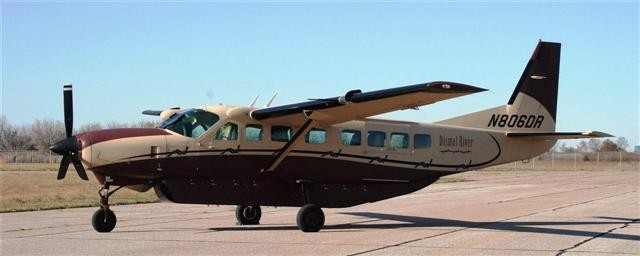
- Exterior: Finished in 2006; Colors are flat tan & brown with barbed wire graphics.
About this Model
Overview
The Cessna 208B Grand Caravan is a high-wing, fixed-gear turboprop designed around payload, simplicity, and off-airport practicality rather than speed or high-altitude cruise. It is commonly operated as a commuter, charter, freight, medevac, and special-mission platform, where quick turnarounds, rugged handling, and a large, reconfigurable cabin are more important than jet-like trip times.
Mission Fit
The Grand Caravan fits missions that value access and payload over speed: short-to-medium legs, frequent stops, and airfields with limited infrastructure. It is especially well suited to operators needing a single type to cover scheduled commuter runs, ad-hoc charter, and freight with minimal changeover time. For longer legs, passengers may experience more cabin noise and weather variability than in pressurized twins or jets.
Cabin
Cabin comfort is utilitarian and highly dependent on the interior and operator configuration. The wide, boxy cross-section supports a range of seat layouts and quick conversion between passengers and cargo. The high wing and tall cabin volume help with headroom and loading, while the large cargo door and low sill height (relative to many aircraft) make bulky items easier to handle. Noise and vibration levels are typical of single-engine turboprops and vary with insulation packages and propeller configuration.