

Specifications
Aircraft Details
- Passenger Capacity: 8 passengers, Executive configuration.
- Interior Features: Gray leather seating, walnut laminate woodwork, dual executive tables, blue gray carpeting, navy blue sidewalls, forward divider with curtain, aft divider with privacy door, belted lavatory.
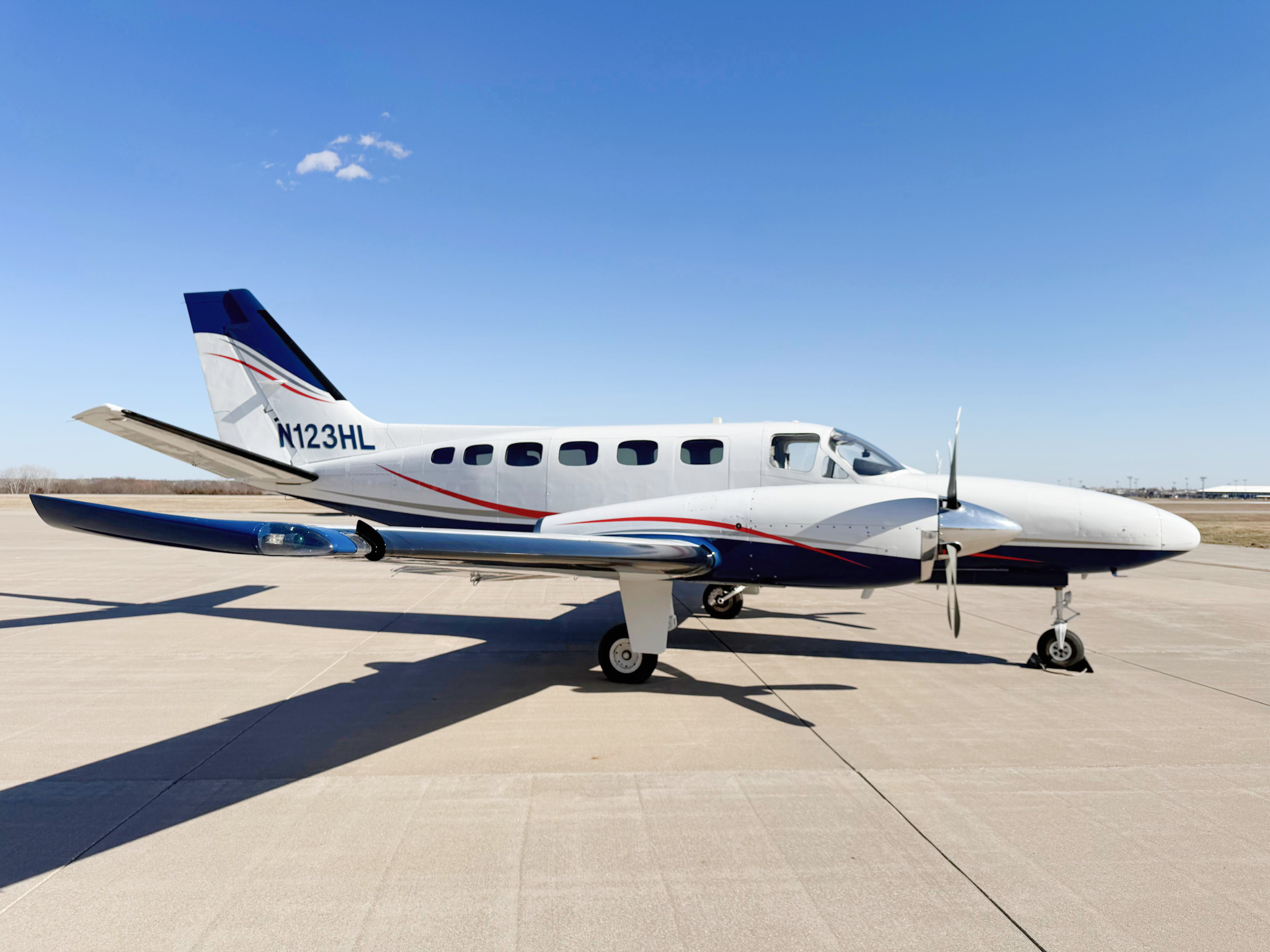
- Exterior Features: Matterhorn white with firecracker red, antique silver, and blue accents; new exterior paint in 2017.
- Avionics: Equipped with Garmin GNS-530, Garmin GTN-750, Garmin G600 EFIS, L3 WX-500 Stormscope, Garmin GTS-855 TCAS-I, Garmin GTX-33ES transponder, and Garmin GWX-70VP weather radar.
- Engine Information: Two TPE331-10N-514S engines, each with 4,199.3 hours since major overhaul, TBO of 5,400 hours.
- Propellers: Number 1 propeller has 0 hours since overhaul; Number 2 propeller has 189.4 hours since overhaul.
- Maintenance Status: Phase 2, 3, and D inspections due by 08/05/2026; previously sustained ground handling damage in December 2018, inspected and repaired.
- Additional Equipment: ADS-B Out, Hartzell 4-blade props, Cleveland wheels and brakes, 35,000-foot altitude certification, lead acid batteries.
About this Model
Overview
The Cessna 441 Conquest II is a cabin-class, pressurized twin-turboprop designed to bridge the gap between light turboprops and entry-level business jets. It is typically selected for owner-operator and managed operations that value turbine reliability, short-to-medium stage efficiency, and access to airports where jets may be less practical due to runway length, ground infrastructure, or operating costs. Exact performance and equipment vary meaningfully by year, STCs, and avionics/engine programs, so aircraft-by-aircraft configuration review matters.
Mission Fit
The Conquest II tends to fit missions in the few-hundred to roughly thousand-nautical-mile class depending on payload, winds, reserves, and climb/cruise choices. It is well matched to mixed airport networks (large hubs plus smaller fields) and to schedules with multiple stops, where its turboprop economics and ground handling can be advantageous. If your typical trips are consistently long and speed-sensitive, an entry-level jet may align better; if you prioritize maximum short/rough-field capability, some utility turboprops may be a better fit.
Cabin
The cabin is pressurized and generally arranged as a club-style business interior for a small group, with a cockpit separated from the passenger area and typical amenities geared toward regional travel. Expect a narrower, more upright cabin feel than larger cabin-class turboprops and jets; comfort is strongly influenced by interior refurbishment quality, seating density, and noise/vibration treatments. Baggage is typically split between internal and external areas depending on configuration, so verifying real-world luggage capacity with the intended passenger count is important.