

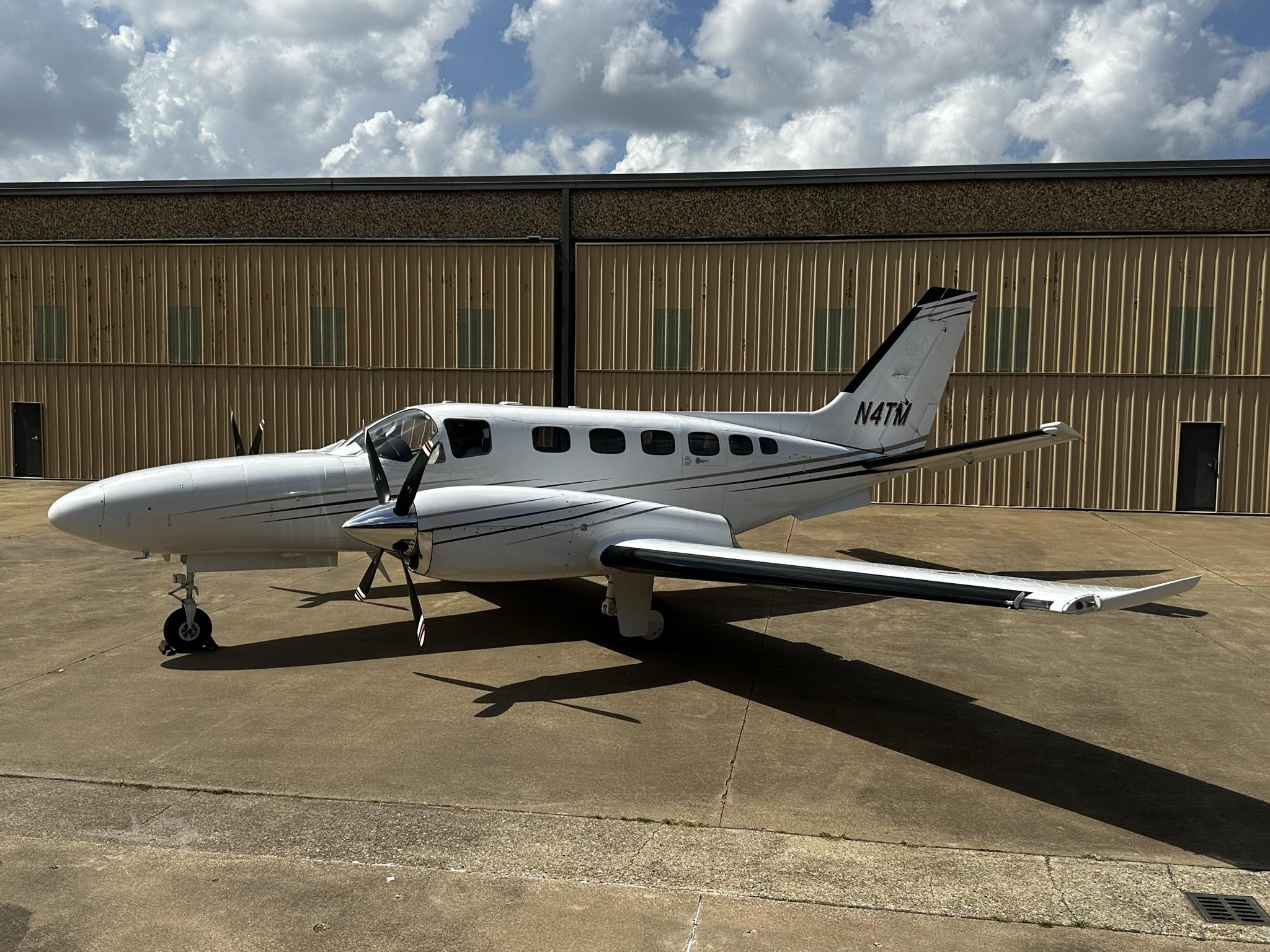
Specifications
Broker
Lone Star Aircraft Sales
Visit websiteNickolas Oviedo
972-977-6272
nick@lonestaraircraftsales.comAircraft Details
- Model: Cessna 441 Conquest II
- Condition: Used
- Flight Rules: IFR
- Range: 1,800 NM
- Max Ramp Weight: 10,240 lb
- Max Takeoff Weight: 10,165 lb
- Max Landing Weight: 9,360 lb
- Max Zero Fuel Weight: 8,815 lb
- Basic Empty Weight: 6,370 lb
- Useful Load: 3,856 lb
- Fuel Capacity Mass: 3,182 lb
- Complete Logs: Yes
- Winglets: Yes
- Engines: 2 x Garrett TPE331-10N-512S
- Engine Time: 3,070 SMOH each
- Engine TBO: 5,000 hours
- Propellers: 4-blade McCauley, 66 SMOH each
- Avionics: Dual Garmin G600 TXI, Dual Garmin GTN 750, ADS-B equipped
- Features: Pressurized, FIKI, Aft Lavatory, Flushing Lav, RVSM certified
- Interior: 9 seats, mid galley, aft lavatory, good condition
- Exterior: Painted in 2007, overall great condition with minor wear
- Maintenance: All SID inspections completed, currently maintained by a twin Cessna shop in Dallas, Texas.
About this Model
Overview
The Cessna 441 Conquest II is a cabin-class, pressurized twin-turboprop designed to bridge the gap between light turboprops and entry-level business jets. It is typically selected for owner-operator and managed operations that value turbine reliability, short-to-medium stage efficiency, and access to airports where jets may be less practical due to runway length, ground infrastructure, or operating costs. Exact performance and equipment vary meaningfully by year, STCs, and avionics/engine programs, so aircraft-by-aircraft configuration review matters.
Mission Fit
The Conquest II tends to fit missions in the few-hundred to roughly thousand-nautical-mile class depending on payload, winds, reserves, and climb/cruise choices. It is well matched to mixed airport networks (large hubs plus smaller fields) and to schedules with multiple stops, where its turboprop economics and ground handling can be advantageous. If your typical trips are consistently long and speed-sensitive, an entry-level jet may align better; if you prioritize maximum short/rough-field capability, some utility turboprops may be a better fit.
Cabin
The cabin is pressurized and generally arranged as a club-style business interior for a small group, with a cockpit separated from the passenger area and typical amenities geared toward regional travel. Expect a narrower, more upright cabin feel than larger cabin-class turboprops and jets; comfort is strongly influenced by interior refurbishment quality, seating density, and noise/vibration treatments. Baggage is typically split between internal and external areas depending on configuration, so verifying real-world luggage capacity with the intended passenger count is important.