

Specifications
Broker
Aircraft Details
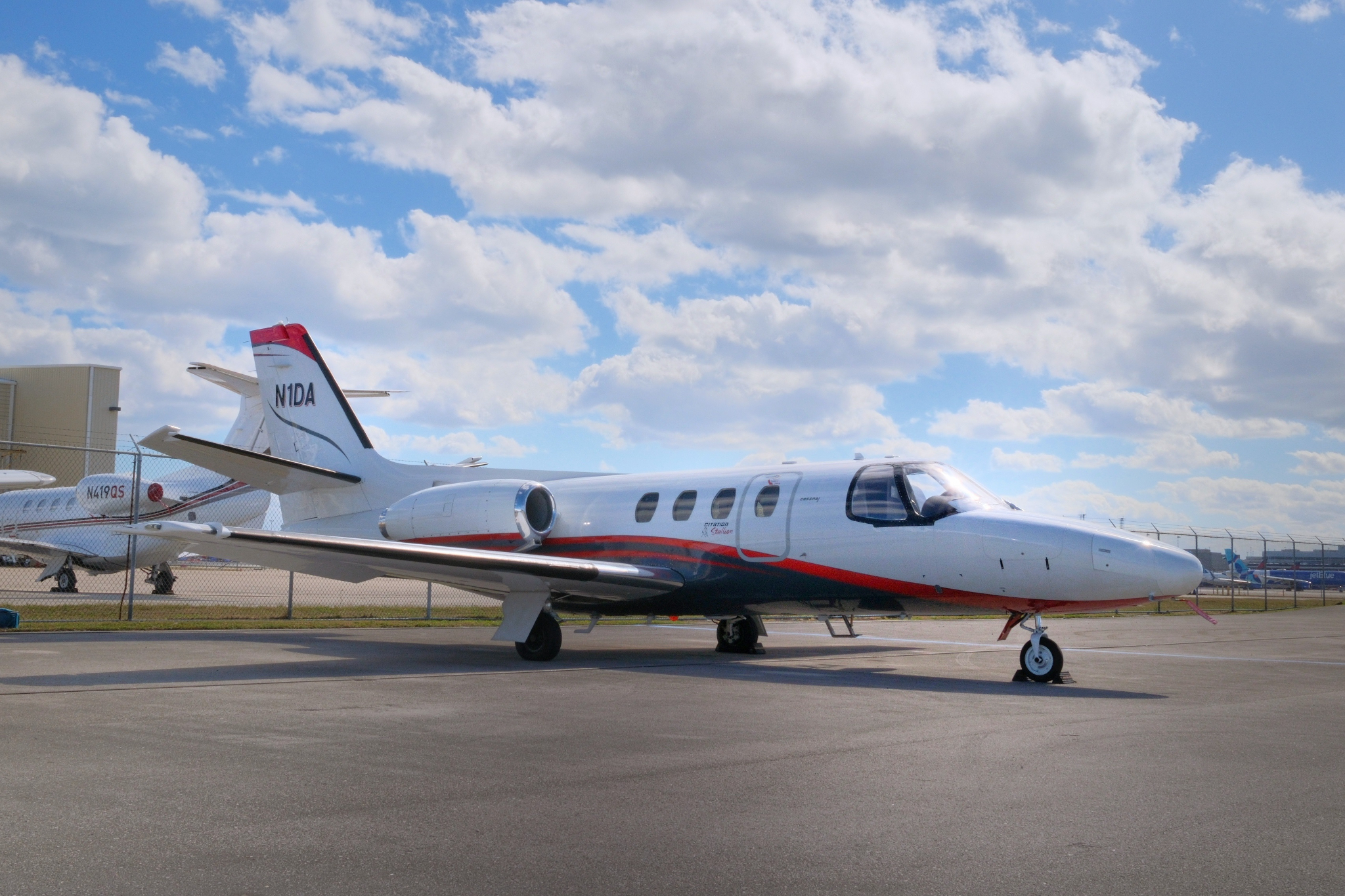
- Model: Cessna Citation 500 Stallion
- Engines: Williams FJ44-2A (2 engines)
- Engine Maintenance Program: TAP Blue
- Total Time: 9,339.5 hours
- Total Landings: 9,662
- Avionics:
- Dual Garmin GTN-750
- Collins ADF-60
- Sperry SPZ-500 IFCS
- Fairchild GA100
- Collins DME-40
- Collins ALT-50
- BFGoodrich WX-500
- Honeywell KGP-560
- Avidyne TAS-620
- Dual Collins TDR-90
- Collins ART-2000VP
- Interior: Executive 7-passenger configuration with forward galley, forward bench seating, 2-place aft-facing club seating, and aft 3-place bench
- Exterior: White upper and charcoal gray lower with deep red trim
- Recent Maintenance: Phase 5 inspection completed in May 2025
- Modifications: Sierra FJ44 Stallion modification completed in 2006
- Equipped with RVSM, ADS-B Out, and Freon air conditioning
About this Model
Overview
The Cessna Citation 500 (often referred to as Citation I, with the single-pilot-capable Citation I/SP variant) is an early 1970s–era light jet designed around predictable handling, conservative performance, and a practical cabin for small groups. It sits in the “classic light jet” category: typically used for regional business travel, owner-operator flying (where equipped and approved), and missions where runway access and simplicity matter more than long-range capability or modern avionics integration.
Mission Fit
In typical day-to-day use, the Citation 500 is a practical platform for multi-leg schedules within a region, with comfortable cruise and a cabin suited to small teams. Buyers usually choose it for reliable point-to-point access rather than pushing the edge of range with full seats and bags. Performance and payload are sensitive to temperature, runway length, and climb requirements, so real-world mission planning should reflect the specific serial number, engine rating, and any STCs.
Cabin
The cabin is a classic light-jet environment with club-style seating common and a compact refreshment and lavatory arrangement depending on interior. Expect a narrower cross-section and lower ceiling than midsize jets; comfort is best with smaller groups and shorter-to-moderate stage lengths. Noise levels and cabin amenities vary widely by refurbishment quality and insulation upgrades.