

Specifications
Broker
Aircraft Details
- Owner History: Original owner was John Travolta; current owner for 30 years.
- Total Time: 4,998 hours.
- Engines: Pratt & Whitney JT15D-1A; overhauled in December 2003; approximately 1,610 hours since overhaul; 3,500-hour TBO.
- Seating: 5-7 passengers; single pilot certified.
- Cabin Dimensions: Height: ~4 ft 9 in; Width: ~4 ft 10 in; Length: ~11 ft.
- Cruise Performance: Cruise speed: ~380 KTAS; Max cruise: ~410 KTAS; Range: ~1,200 NM; Service ceiling: 41,000 ft; Rate of climb: ~3,000 FPM.
- Takeoff/Landing Distances: Initial takeoff distance: ~3,300 ft; Landing distance: ~2,600 ft.
- Fuel Capacity: ~5,000 lbs usable; fuel burn: ~1,200-1,300 lbs/hr (first hour), ~900-1,000 lbs/hr (cruise average).
- Maintenance: All maintenance tracked in CESCOM; RVSM compliant; recent hydrostatic tests completed.
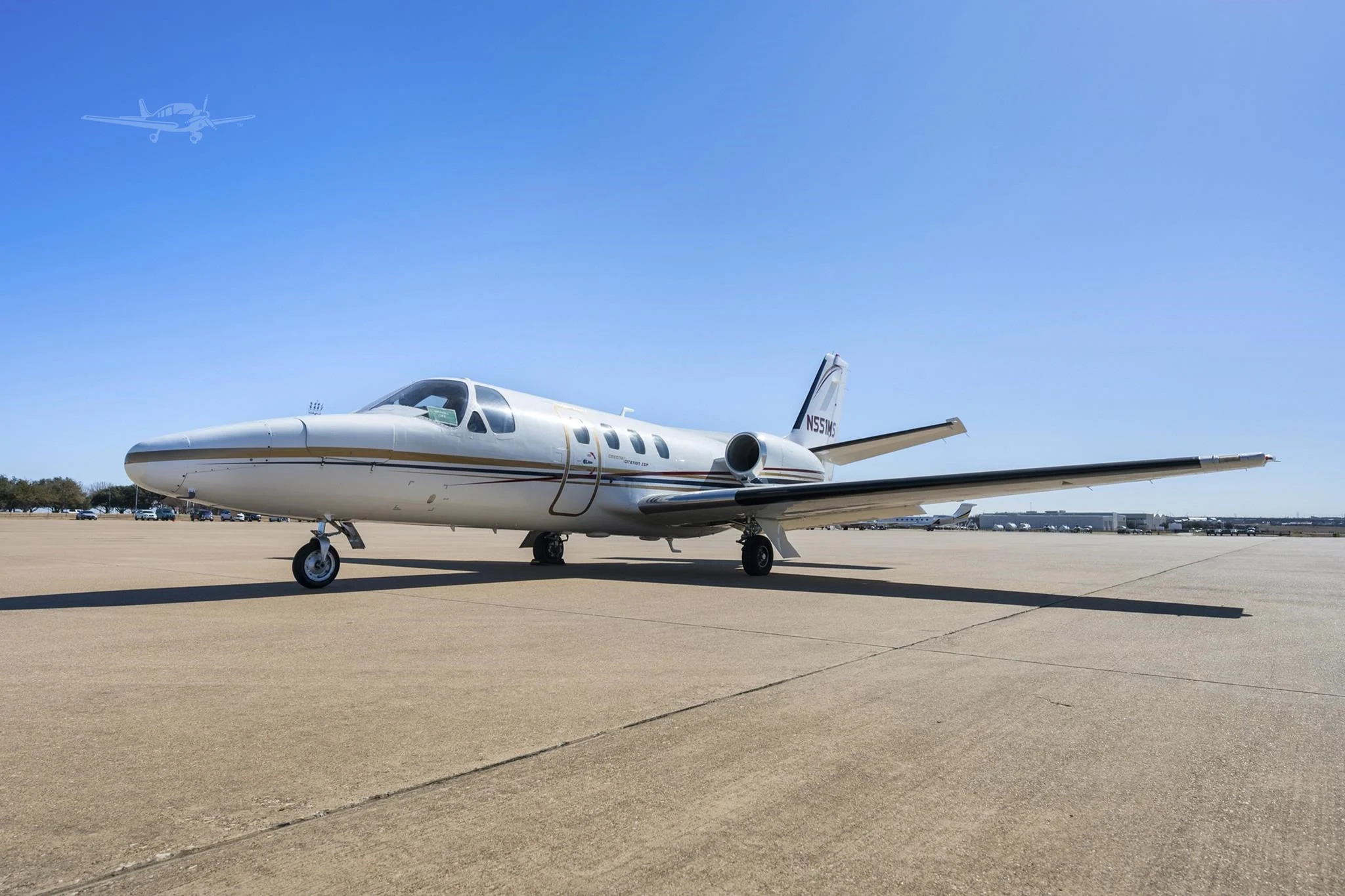
- Exterior: Remarkably nice paint; colors: Matterhorn white with gold, blue, and red/burgundy stripes.
- Interior: Beige leather seating, aft-facing barrel seat; walnut woodwork and cabinetry; belted aft lavatory; forward refreshment center.
About this Model
Overview
The Cessna Citation 500 (often referred to as Citation I, with the single-pilot-capable Citation I/SP variant) is an early 1970s–era light jet designed around predictable handling, conservative performance, and a practical cabin for small groups. It sits in the “classic light jet” category: typically used for regional business travel, owner-operator flying (where equipped and approved), and missions where runway access and simplicity matter more than long-range capability or modern avionics integration.
Mission Fit
In typical day-to-day use, the Citation 500 is a practical platform for multi-leg schedules within a region, with comfortable cruise and a cabin suited to small teams. Buyers usually choose it for reliable point-to-point access rather than pushing the edge of range with full seats and bags. Performance and payload are sensitive to temperature, runway length, and climb requirements, so real-world mission planning should reflect the specific serial number, engine rating, and any STCs.
Cabin
The cabin is a classic light-jet environment with club-style seating common and a compact refreshment and lavatory arrangement depending on interior. Expect a narrower cross-section and lower ceiling than midsize jets; comfort is best with smaller groups and shorter-to-moderate stage lengths. Noise levels and cabin amenities vary widely by refurbishment quality and insulation upgrades.