

Specifications
AI Description
- Engines: Two Pratt & Whitney PW530A engines; Engine 1: 10,071 hours, 6,027 cycles; Engine 2: 10,001 hours, 5,953 cycles.
- Maintenance Programs: Enrolled on JSSI and ProParts.
- Avionics: Honeywell Primus 1000 three-tube display; dual Honeywell KY-196B comm radios; dual Honeywell KN-53 nav radios; Honeywell autopilot; dual Honeywell KR-87 ADF; dual Honeywell DN-441B DME; Collins ALT-55B radar altimeter; dual Honeywell KT-74 transponder; Honeywell WU-660 radar; Universal UNS-1K FMS; Garmin G400 GPS; Honeywell Mark VII EGPWS; Fairchild A2000S CVR; Artex C406-2 ELT; Honeywell TPU 67B TCAS II.
- Interior: Seats eight; center club configuration; two aft forward-facing seats; enclosed belted aft lavatory; recent seat refurbishment.
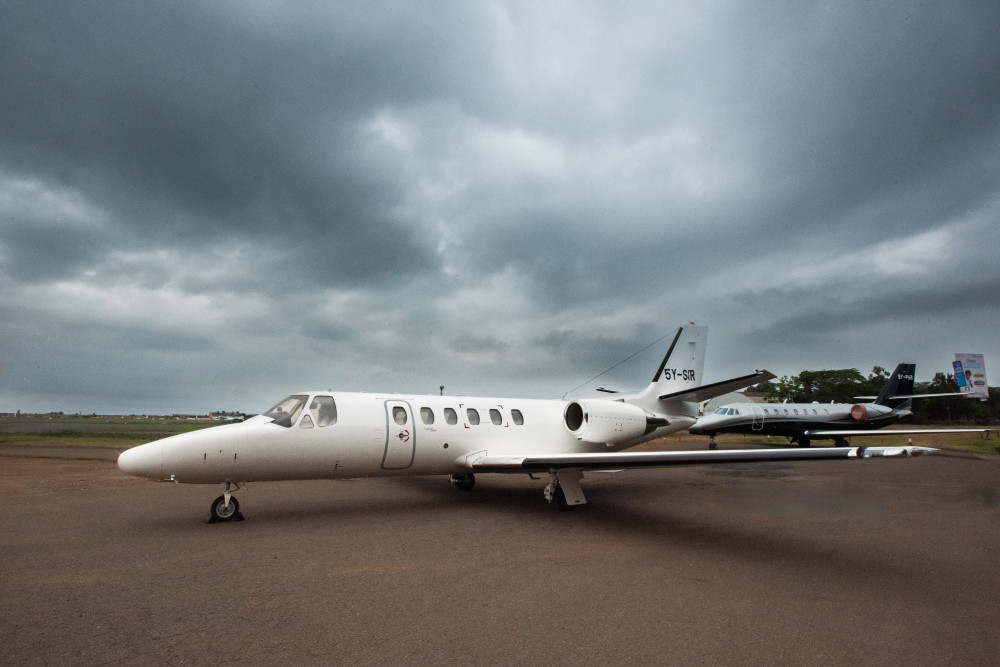
- Exterior: Fresh paint in 2025, overall Matterhorn white.
- Weights: Max takeoff weight: 14,800 lbs; max landing weight: 13,500 lbs; max zero fuel weight: 11,300 lbs; empty weight: 9,114 lbs.
- Compliance: RVSM and B-RNAV compliant; ADS-B equipped.
- Inspection Status: Pre-purchase inspection due October 2025; various phases due September 2025.
About this Model
Overview
The Citation Bravo is a twin‑engine light business jet positioned between entry-level Citations and larger light/midsize platforms. It is typically selected for 4–7 passenger missions where access to shorter runways and predictable operations matter more than maximum cabin volume. Compared with earlier Citation II variants, the Bravo’s higher-thrust engines and aerodynamic refinements are aimed at improved climb and hot/high performance, while keeping a conventional systems layout and pilot-friendly handling.
Mission Fit
In real use, the Bravo is most efficient on short to mid-length legs where block times and airport access drive value. It can cover longer segments, but payload, reserves, and seasonal winds can make the longest missions less practical versus newer or larger jets. If your typical day involves multiple short hops, quick climbs, and consistent dispatch from a variety of airports, the Bravo aligns well.
Cabin
The cabin is a classic light-jet cross-section: a compact aisle with club-style seating common, adequate headroom for seated comfort, and a focus on practicality rather than spaciousness. Noise levels and ride quality are typical for its generation; passenger comfort is strongly influenced by interior condition, refurbishment history, and insulation upgrades. Baggage is generally manageable for soft bags and typical business travel loads, with loading convenience dependent on the specific aircraft’s interior and baggage arrangement.