

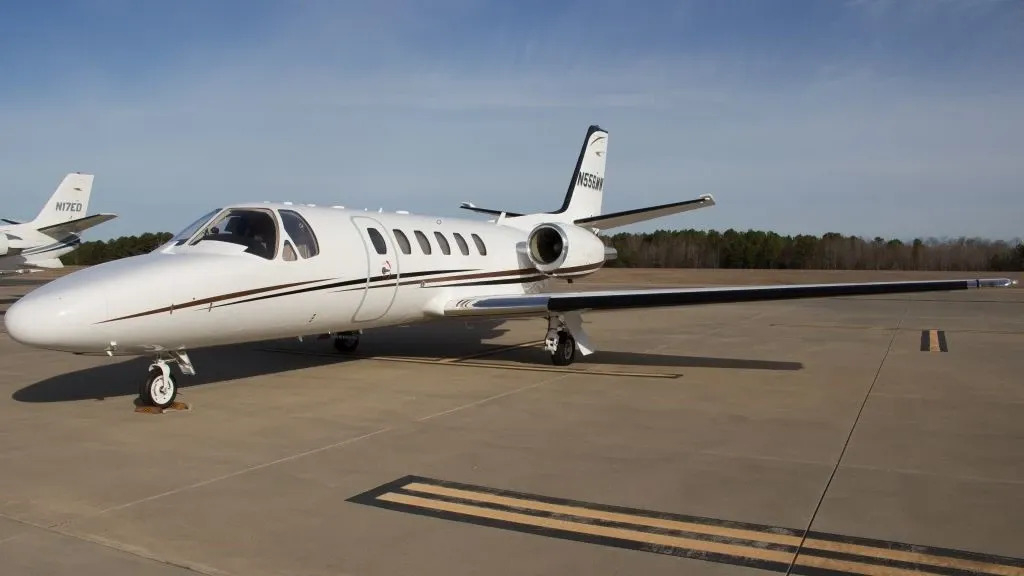
Specifications
Broker
Aircraft Details
- Maintenance:
- Maintained under FAR Part 91
- Airframe maintenance program: ProParts
- Airframe tracking program: CESCOM (Cessna Computerized)
- RVSM certified
- Phase 1-4 inspections completed December 2010; Phase 5 inspection due December 2012
- Engines:
- Model: PW530A
- Total time since new for each engine: 2125 hours
- TBO: 4000 hours
- Avionics:
- Honeywell KR-87 ADF
- Honeywell Primus 1000 IFCS autopilot and flight director
- Honeywell Primus 1000 3-tube EFIS
- Dual Honeywell KY-196A communication radios
- Dual Honeywell DM-441B DME
- Universal UNS-1K FMS with GPS
- Honeywell EGPWS TAWS
- Honeywell TCAS-I
- Honeywell Primus 660 weather radar
- Interior:
- Seating for 8 in executive configuration
- Taupe leather seating with various seating arrangements
- Aft lavatory
- High-gloss walnut veneer cabinetry
- Mocha carpeting and bone headliner
- Exterior:
- Color scheme: White with light blue and dark blue stripes
- Additional Equipment:
- Thrust reversers, EROS oxygen masks, overwater life vests, ski tube
About this Model
Overview
The Citation Bravo is a twin‑engine light business jet positioned between entry-level Citations and larger light/midsize platforms. It is typically selected for 4–7 passenger missions where access to shorter runways and predictable operations matter more than maximum cabin volume. Compared with earlier Citation II variants, the Bravo’s higher-thrust engines and aerodynamic refinements are aimed at improved climb and hot/high performance, while keeping a conventional systems layout and pilot-friendly handling.
Mission Fit
In real use, the Bravo is most efficient on short to mid-length legs where block times and airport access drive value. It can cover longer segments, but payload, reserves, and seasonal winds can make the longest missions less practical versus newer or larger jets. If your typical day involves multiple short hops, quick climbs, and consistent dispatch from a variety of airports, the Bravo aligns well.
Cabin
The cabin is a classic light-jet cross-section: a compact aisle with club-style seating common, adequate headroom for seated comfort, and a focus on practicality rather than spaciousness. Noise levels and ride quality are typical for its generation; passenger comfort is strongly influenced by interior condition, refurbishment history, and insulation upgrades. Baggage is generally manageable for soft bags and typical business travel loads, with loading convenience dependent on the specific aircraft’s interior and baggage arrangement.