

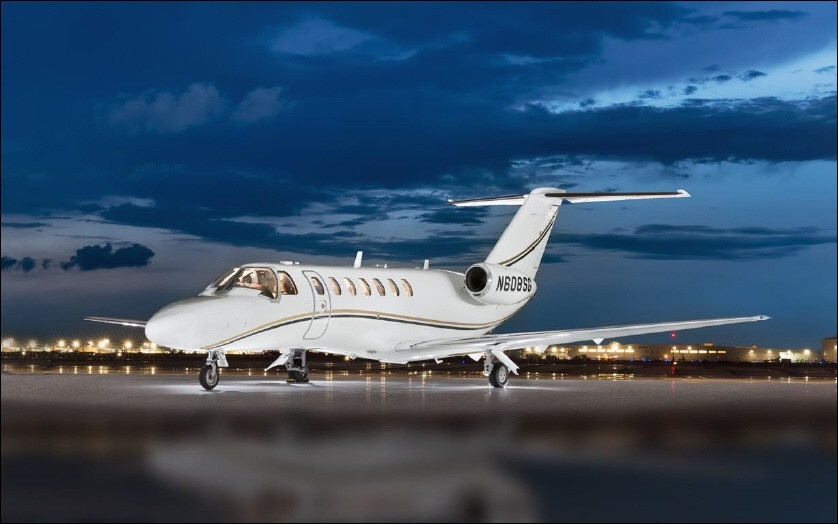
Specifications
Aircraft Details
- Avionics: Collins Pro Line Fusion, dual Collins VHF-4000 radios, L3 FA2100 CVR, dual Collins FMSA-6000, dual Collins GPS-4000S, Honeywell Mark V EGPWS, Collins TTR-4000 TCAS-II.
- Engines: Two Williams FJ44-3A engines, both with 5,830 hours since new and 4,843 cycles.
- Interior: Seats 8, forward galley, aft belted lavatory, original interior refurbished in 2008, features a forward side-facing seat, four-place club, and dual aft forward-facing seats.
- Exterior: Matterhorn white with granite and gold flowing stripes, last painted in 2008.
- Maintenance: Cessna ProParts maintenance tracking, TAP Elite engine program, maintained under FAR Part 135.
- Features: Equipped with Gogo Avance L3 Wi-Fi, synthetic vision technology, RVSM, ADS-B capability, and cockpit/cabin fire extinguishers.
- Inspection Status: Various inspections due between 2024 and 2028, including DOC 8 and DOC 16 due August 2028.
About this Model
Overview
The Citation CJ3 sits in the light-jet segment as a step-up from entry-level light jets, focusing on predictable day-to-day dispatch, access to a broad set of runways, and a cabin sized for typical 4–6 passenger business trips. It is commonly used for regional and multi-stop schedules where turn time, straightforward avionics, and manageable operating complexity matter as much as cruise capability.
Mission Fit
A CJ3 is most at home on short-to-midrange stage lengths, including out-and-back days and multi-stop itineraries. It can support longer legs depending on payload, winds, and reserves, but the most consistent use case is efficient regional coverage rather than routine transcontinental flying at higher passenger counts.
Cabin
The CJ3 cabin is arranged around a center aisle with opposing club seating in the main cabin and an enclosed aft lavatory. The cabin height and width are typical for the light-jet class, with a step-down or slight floor contouring depending on interior generation and refurbishment. Noise levels, ride comfort, and environmental control are generally aligned with modern light jets; perceived comfort depends heavily on interior condition, seat design, and maintenance of seals and environmental systems.