

Specifications
Broker
Aircraft Details
- Maintenance: FAR Part 91, CESCOM tracking, RVSM certified, no damage history.
- Upcoming maintenance: Phase 5 Inspection due by February 2025, 12-Month and 24-Month Inspections due by July 2024.
- Engine model: JT15D-4; Left engine overhauled in January 2012, Right engine overhauled in January 2018.
- Additional equipment: 64 cubic foot oxygen system, Branson high gross weight modification, Cleveland wheels & brakes, Sierra quick-release radome, aft baggage modification, Med-Pac air medical stretcher STC.
- Avionics: Collins ADF-60A, Sperry SPZ-500 IFCS autopilot, dual Collins VHF-20A radios, Collins DME-40, Garmin GTN-625 GPS, Avidyne FlightMax EX-850 MFD, dual Collins VIR-30A navigation radios, Sperry AA-215 radar altimeter, Garmin GTX-335R and GTX-345R transponders, Bendix/King RDR-1200 weather radar.
- Features: Aft lavatory, CESCOM equipped, RVSM equipped, freon air conditioning, ADS-B capable, standard terrain awareness & warning system, traffic collision avoidance system, and flight management system.
- Interior: Refurbished in 2022, executive configuration, seating for 8 in double club layout with beige leather.
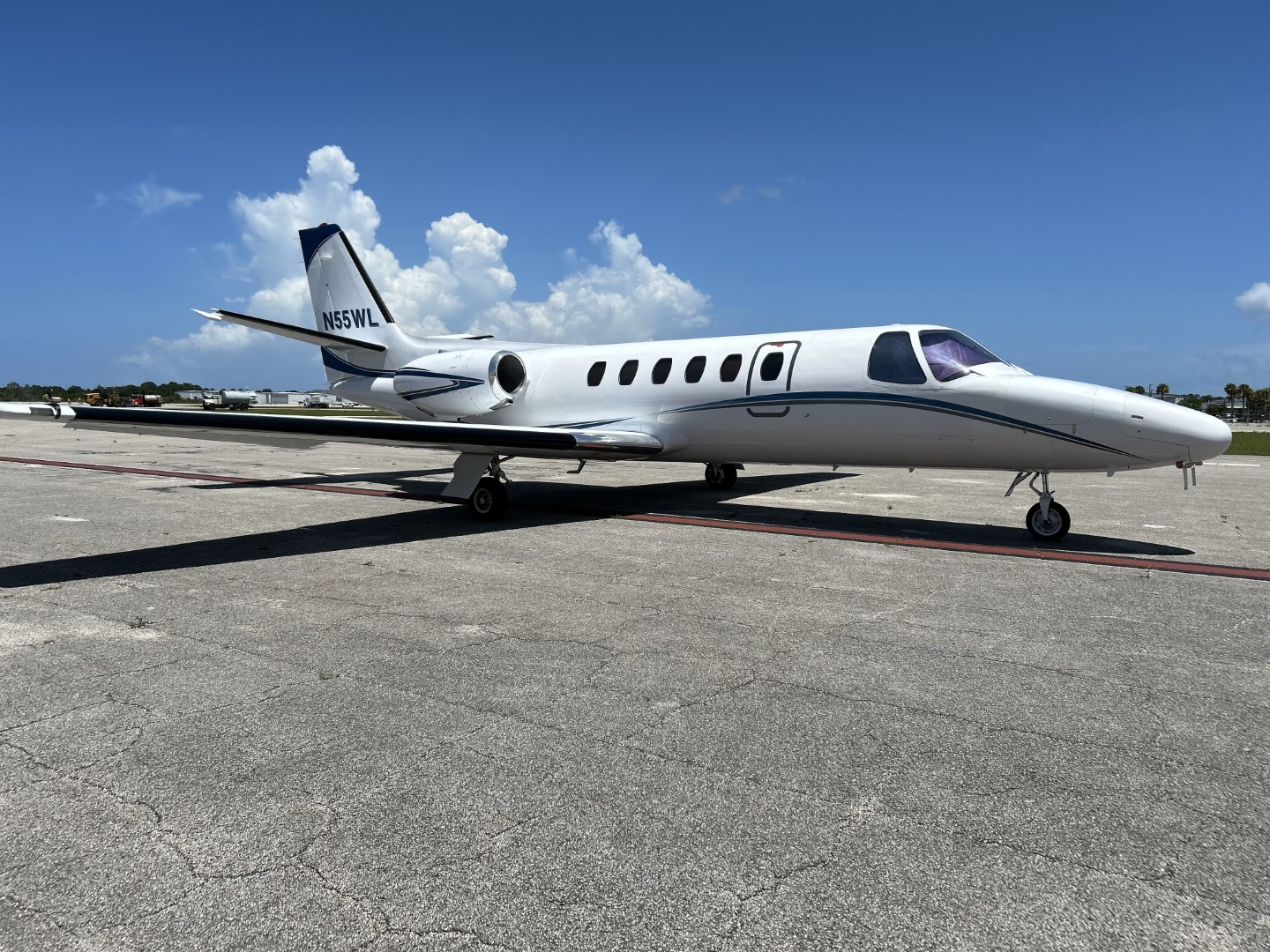
- Exterior: New paint in 2019, Matterhorn white with blue and silver accents.
About this Model
Overview
The Cessna Citation II is an earlier-generation light business jet in the Citation 500-series line, built around predictable handling, conservative aerodynamics, and systems that many operators consider approachable compared with newer, more integrated designs. It is commonly selected for regional business travel, owner-flown professional operations where training and SOPs are well established, and charter-style utilization where cabin comfort matters but large-cabin capability is not required.
Mission Fit
Mission planning typically centers on short-to-midrange legs with reserves that keep the aircraft within comfortable payload limits. The Citation II can serve as a dependable step-up from turboprops or entry-level light jets when the goal is jet speed and pressurization without moving into the complexity and operating scale of midsize types.
Cabin
Cabin volume and seating are oriented to practical business travel rather than a lounge-like environment. Typical layouts provide a compact club arrangement with an enclosed or semi-enclosed lavatory depending on configuration. Noise levels, aisle space, and overall fit-and-finish vary significantly with interior refurbishment history, so cabin perception is highly aircraft-specific.