

Specifications
Broker
Aircraft Details
- Maintenance: Maintained under FAR Part 91, RVSM certified, JSSI engine maintenance program.
- Engines: TFE731-4R-2S model, two engines with TBO of 4200 hours.
- Additional Equipment: EROS oxygen system, dual 42-amp lead acid batteries, automatic power reserve, baggage heater, therapeutic oxygen, tail flood light, second red rotating beacon.
- Avionics: Equipped with Collins ADF-462, Honeywell AFIS, Honeywell AHZ-600, Honeywell SPZ-8000 IFCS autopilot, dual Collins VHF-22 radios, Fairchild GA100 CVR, dual Collins DME-42, Honeywell 5-tube EFIS, dual Universal UNS-1K FMS with GPS, King KHF-950 HF radio, dual Collins VIR-32 navigation radios, Collins ALT-55 radar altimeter, Honeywell Mark VII TAWS, AlliedSignal TCAS-II, dual Honeywell MST-67A transponders, Honeywell Primus 870 weather radar.
- Features: Equipped with aft lavatory, belted lav, flushing lav, engine maintenance program, auxiliary power unit, ADS-B capability, terrain awareness & warning system, traffic collision avoidance system, thrust reversers, dual flight management systems, and weather radar.
- Interior: Executive configuration for 8 passengers, fireblocked tan interior, 2-place side-facing divan, mid-cabin 4-place club seating, tan carpeting, forward refreshment center, high-gloss maple veneer cabinetry, entertainment equipment with monitors and CD.
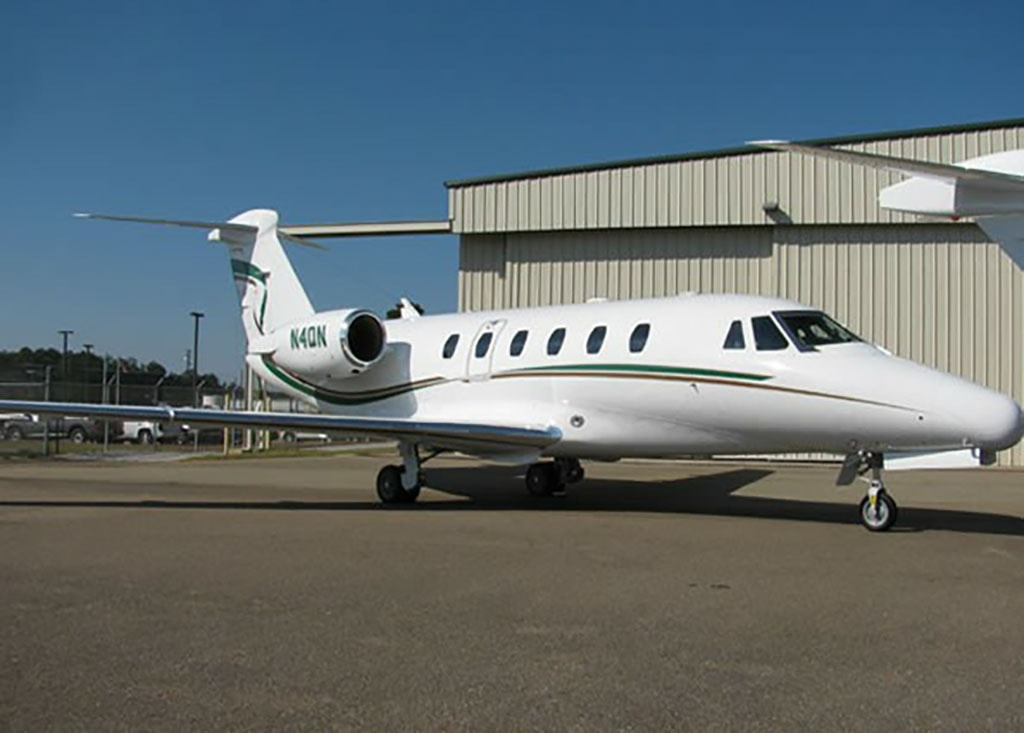
- Exterior: Completed in 2009, white with shamrock green and Tibetan gold accents.
About this Model
Overview
The Cessna Citation VII is a 1990s-era midsize business jet positioned between light Citation models and larger super-midsize aircraft. It emphasizes predictable handling, solid short-to-mid range capability, and a conventional cabin layout suited to business travel. Most aircraft in the fleet are now heavily mission-tailored through avionics and interior upgrades, so individual configuration matters more than the baseline type description.
Mission Fit
In practical use, the Citation VII is well matched to 1.5–3.5 hour sectors and city-pair flexibility where cruise efficiency and reliable climb/cruise performance matter more than maximum range. It can cover longer stage lengths depending on winds, payload, and alternates, but planning should assume the need for flexibility rather than guaranteed nonstop capability at full cabin load.
Cabin
The cabin is a classic midsize-jet environment: a double-club style seating arrangement is common, with an enclosed lavatory and a compact refreshment area. Expect a comfortable seated workspace for a small team, with a narrower aisle and limited stand-up movement compared with newer super-midsize designs. Noise and vibration levels vary by interior condition and refurbishment quality, so cabin refurbishment history is a major differentiator among airframes.