

Specifications
Broker
Aircraft Details
- Maintenance:
- Maintained under FAR Part 91
- Airframe maintenance program: ProParts
- Airframe tracking program: CESCOM (Cessna Computerized)
- Certifications: RVSM
- Weights: Ramp 36,400 lbs, MTOW 36,100 lbs, Empty 21,600 lbs, BOW 22,100 lbs, Max Fuel 13,031 lbs
- Additional Equipment:
- Elliptical winglets
- Heated & pressurized aft external luggage bay
- 400-pound gross weight increase mod
- EROS oxygen masks
- Aileron re-gearing mod
- Elevator bracket and replacement mods
- Tail logo light
- Engine:
- Model: AE3007C
- Maintenance program: JSSI
- Engine 1 TTSNEW: 7,455 hrs, TCSN: 5,011 hrs, TBO: 6,000 hrs
- Engine 2 TTSNEW: 7,485 hrs, TCSN: 5,036 hrs, TBO: 6,000 hrs
- Avionics:
- Honeywell Primus 2000 avionics package
- Dual Collins VHF-422A communication radios
- Honeywell GPS (dual 12-channel)
- Honeywell Mark V EGPWS w/windshear
- TCAS-II w/change 7
- Interior:
- Capacity: 8 passengers
- Executive configuration with custom plush beige leather double club seating
- Forward galley with enclosed oven and coffee station
- External-serviceable flushing aft lavatory with vanity
- Exterior:
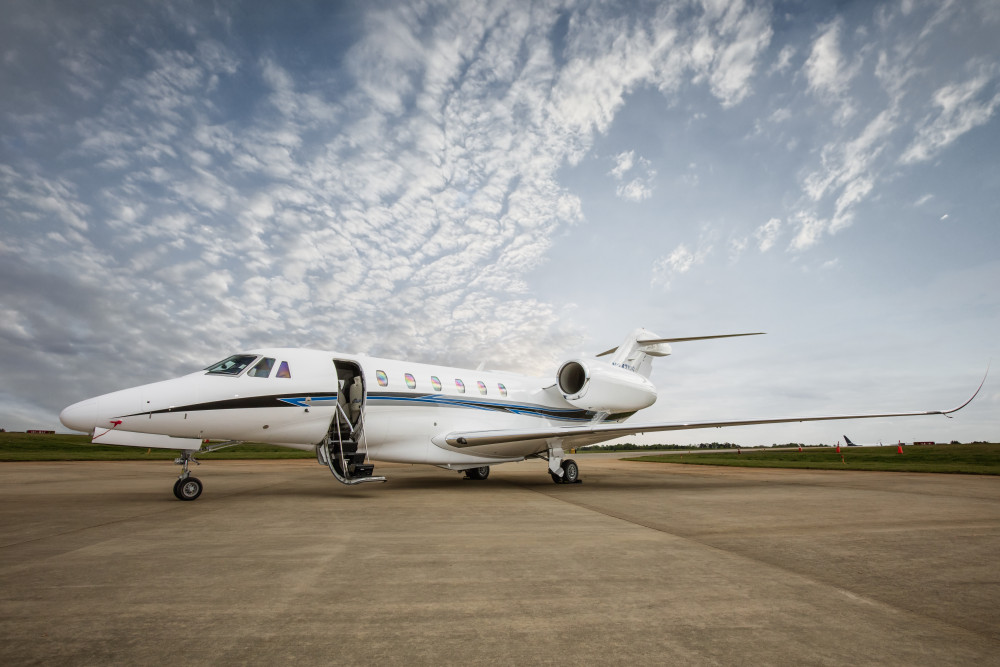
- Colors: White with Aristo blue and beige accent stripes
About this Model
Overview
The Cessna Citation X is known for prioritizing cruise speed and efficient high-altitude operation in a super-midsize footprint. It targets operators who value shorter block times on long domestic and near-transatlantic stage lengths while keeping a Citation-style operating concept—single manufacturer support ecosystem, straightforward cabin systems, and a cockpit built around integrated avionics.
Mission Fit
Citation X missions tend to center on getting 6–8 passengers to destination quickly while maintaining good access to secondary airports. It is a fit when speed is a primary driver and typical trip lengths sit in the 1,500–3,000 nm band, with occasional longer legs depending on winds, routing, and payload.
Cabin
The cabin is arranged to support business travel with a conventional double-club layout in many aircraft, a forward galley area, and an enclosed lavatory. Compared with larger-cabin jets, aisle width and overall volume are more constrained, but the environment is generally quiet at cruise and well-suited to working in flight. Storage is adequate for common business baggage, with loading and exact volume varying by configuration and options.