

Specifications
Aircraft Details
- Outstanding US pedigree
- Low airframe total time
- Desired 10 passenger configuration
- Enrolled on full programs
- 88 parameter flight data recorder (FDR)
- Avance L5 connectivity
- Home base: Dallas, TX
- Engines: Pratt & Whitney PW308C
- Engine 1: 5,381 hours since new, 5,305 cycles
- Engine 2: 2,505 hours since new, 2,479 cycles
- Auxiliary Power Unit (APU): GTCP36-150, 3,669 hours since new, enrolled on MSP
- Avionics: Honeywell EASY II system with multiple dual units including EFIS, FMS, GPS, and TCAS
- RVSM compliant
- Meggitt secondary flight display & ADS-B out
- WAAS/LPV capable
- ELTA 406 MHz ELT
- Securaplane video tail camera
- Teleflex recognition lights
- Interior: Fireblocked, 10 passenger seating, aft lavatory, black ebony veneer woodwork, gray carpet, forward bulkhead-mounted 20” LCD monitor
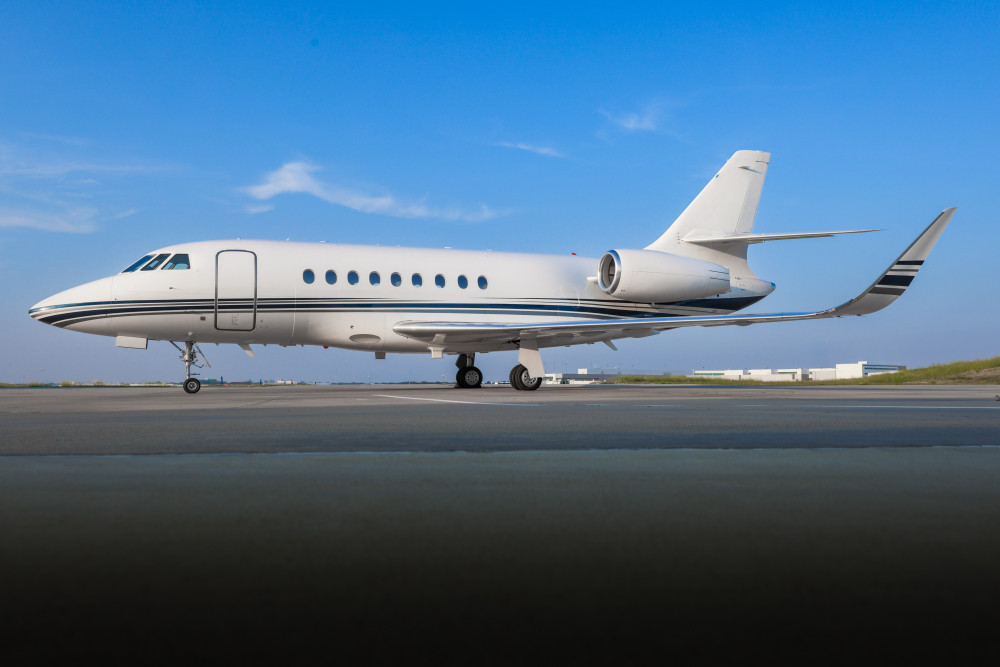
- Exterior: Matterhorn white with Ming blue and medium silver metallic stripes, last painted May 2017
About this Model
Overview
The Falcon 2000LX sits in the large-cabin segment with an emphasis on combining a wide, comfortable cabin with the operational flexibility associated with Dassault’s wing design and systems philosophy. It is commonly selected by operators who want a true large-cabin environment for 8–10 passengers while retaining access to a broader set of airports than many long-range heavy jets, including shorter runways and airports with performance constraints. The “LX” variant is defined by added range capability over earlier Falcon 2000 versions while keeping the same general cabin cross-section and mission intent.
Mission Fit
In day-to-day use, the 2000LX is a strong fit for coast-to-coast U.S.-style missions and high-frequency regional-to-transcontinental flying where cabin comfort and airport flexibility are both important. It is less aligned with nonstop intercontinental profiles that demand significantly more range or with buyers who want a “latest-gen” flight deck experience out of the box.
Cabin
The cabin is known for its width and a layout that supports productive work and quieter conversation, with enough volume for multiple living zones depending on configuration. Typical arrangements seat 8–10 in a club and conference grouping, with an enclosed aft lavatory and a forward galley area. Baggage capacity is suitable for longer trips, and the cabin cross-section generally feels less restrictive than narrower super-midsize cabins, especially for shoulder room and aisle movement.