

Specifications
Broker
Aircraft Details
- Maintenance: Maintained under FAR Part 91; CAMP tracking program; RVSM certified.
- Engine: TFE731-5BR-1C model; MSP Gold maintenance program; three engines overhauled in 2004, 2006, and 2006; hot section inspections completed in 2017.
- Inspections: 3C Inspection (2014), 1C Inspection (2020), Landing Gear Overhaul (2020), 36-Month Inspection (2023), 12-Month Inspection (2024).
- Additional Equipment: 115 cubic foot oxygen bottle; emergency altitude power; recognition and precise pulselites.
- Avionics: Dual Collins ADF-60B; Honeywell CMA-6800 EFIS; Dual Honeywell FMZ-2000 FMS; Honeywell Primus 870 weather radar; Dual Collins TDR-94D Mode S transponder; SATCOM capabilities.
- Features: Equipped with aft lavatory, forward galley, engine maintenance program, high-speed data/WiFi, ADS-B, and standard safety systems (TAWS, TCAS, RVSM).
- Interior: Refurbished in April 2024; accommodates 13 passengers; executive configuration; beige quilted leather seating; forward galley with high-temperature oven.
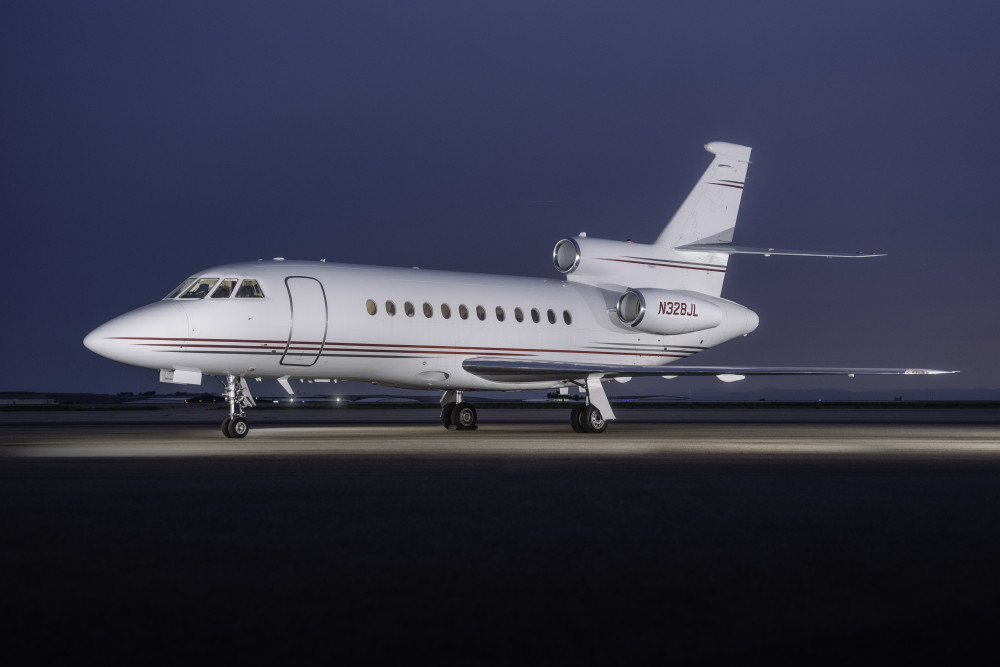
- Exterior: New paint in 2014; white with red and silver accent stripes.
About this Model
Overview
The Dassault Falcon 900 is a large-cabin business jet built around a three‑engine (tri‑jet) architecture, emphasizing range capability, access to shorter or more constrained runways, and redundancy for overwater and remote-region operations. Compared with many twin‑engine peers, the 900 family is often chosen for operators who value mission flexibility—mixing long legs with frequent operations into demanding airports—while maintaining a cabin suited to multi-zone seating and extended time aloft.
Mission Fit
In typical use, the Falcon 900 is a transoceanic-capable aircraft for teams that want a true large-cabin environment without giving up access to more challenging airports. It can be a strong fit for mixed missions—executive transport, government/VIP, and special-mission roles—where payload, range, and airport performance all matter.
Cabin
Cabin layouts commonly support a forward club and additional seating zone(s) aft, with an enclosed lavatory and a galley sized for longer flights. The cabin is generally quiet for its class and designed for extended-duration comfort, with storage and service provisions that suit international stage lengths. Exact seating capacity and zone definition vary by serial number and interior completion.