

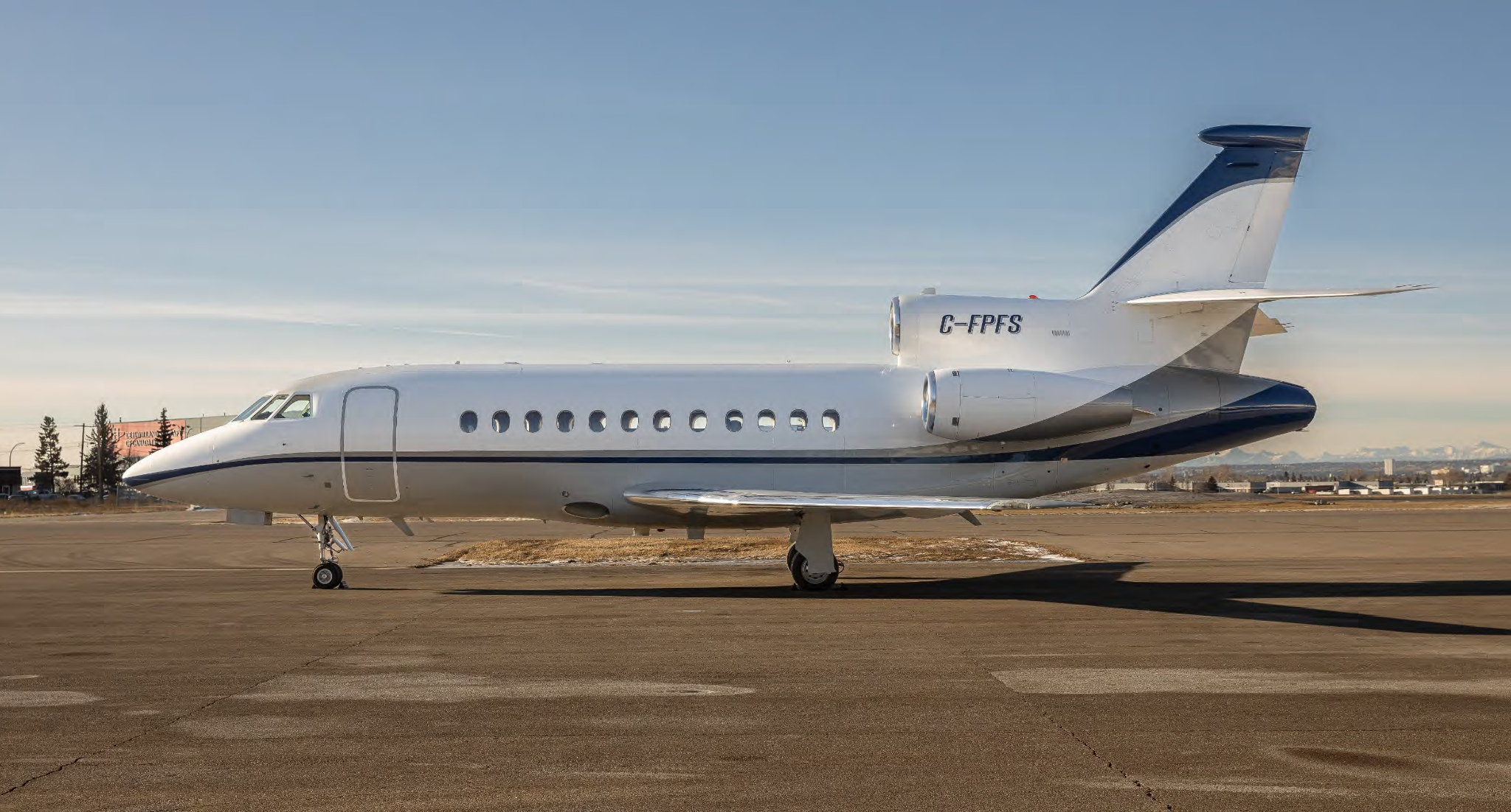
Specifications
Aircraft Details
- Engines: Honeywell TFE731-60-1C; enrolled on MSP Gold program; engine hours: 5,787, 5,829, 5,807; cycles: 2,332, 2,342, 2,386; time to MPI: 101, 107, 129 hours; time to CZI: 1,214, 1,171, 1,193 hours.
- APU: Honeywell GTCP 36-150(F); total time since new: 3,389 hours.
- Avionics: Primus Elite II advanced avionics; Honeywell CD-830 control display unit; synthetic vision system; dual Collins HF-9034A with SELCAL; Collins TCAS-4000; Honeywell Primus 880 weather radar; WAAS/LPV; Honeywell Mark V EGPWS.
- Interior: Fourteen (14) passenger configuration; forward cabin with four executive club seats; mid cabin with two club seats and a three-place divan; aft cabin with a four-place conference group; refurbished in August 2020.
- Exterior: Repainted in October 2011; Matterhorn White upper fuselage, Gamma Gray lower fuselage, Diamond Silver & Blue striping.
- Maintenance: Scheduled for 2C, CZI, and full paint in April 2026; various inspections due between May 2026 and July 2026.
- Entertainment: Baker CMS; GoGo L5 WiFi; GoGo Video Processor Unit (GVPU).
About this Model
Overview
The Falcon 900EX is a large-cabin, long-range business jet built around Dassault’s tri-jet architecture, prioritizing range, high-altitude cruise, and access to a wider set of airports than many long-range peers. It is typically chosen for missions that mix intercontinental legs with occasional performance-constrained runways, while still offering a quiet, conference-capable cabin for 8–14 passengers depending on layout.
Mission Fit
In day-to-day use the 900EX aligns well with long legs at high flight levels, minimizing fuel stops and schedule complexity. It also suits programs that occasionally face hot/high conditions or shorter runways, where the tri-jet configuration and wing design can provide practical dispatch flexibility. If most flying is 1–2 hour sectors, the aircraft’s capability may exceed the mission and increase operating complexity relative to smaller types.
Cabin
Cabins are typically arranged with a forward galley, a main seating area with club configuration, and an aft lounge or conference grouping, plus an enclosed lavatory. The cross-section supports comfortable aisle movement, and the long cabin length enables separation between work and rest zones. Sound levels are generally favorable for calls and meetings at cruise, and baggage volume is geared for multi-day international travel.