

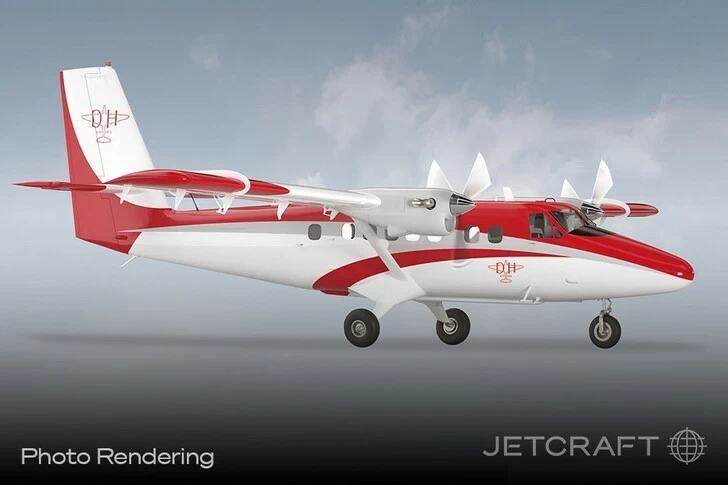
Specifications
Broker
Aircraft Details
- Full factory warranty and training provisions.
- Delivery scheduled for October 2026.
- Proven Twin Otter performance with updated avionics.
- Equipped with Pratt & Whitney Canada PT6A-27 engines.
- Hot section inspection due at 1,800 hours; overhaul due at 3,600 hours.
- Integrated Garmin G1000NXI avionics suite with dual displays and multiple navigation systems.
- Maximum takeoff weight: 5,670 kg (12,500 lbs).
- Maximum landing weight: 5,579 kg (12,300 lbs).
- Operating weight: 3,175 kg (7,000 lbs).
- Passenger capacity: 19 in standard configuration.
- Forward cabin: 5 rows of 1x2 economy seats; aft cabin: single economy seat opposite entry door and aft 3-place economy seat bench.
- Additional features: provisions for under-seat stowage, lap-type safety belts, LED overhead lighting, and cabin air outlets.
- Float provisions and optional configurations available, including VIP and amphibious floats.
- STOL capable and can be operated by single or dual pilots.
- Additional corrosion protection and stainless steel flight control cables.
About this Model
Overview
The DHC-6-300 Twin Otter is a high-wing, fixed-gear twin turboprop designed to move people and cargo into and out of short, unimproved runways with limited support infrastructure. The -300 variant is a widely used production standard, commonly operated for regional transport, island and coastal shuttles, utility logistics, and special-mission roles where predictable STOL capability matters more than cruise speed.
Mission Fit
Mission planning typically centers on runway length/condition, payload at temperature and elevation, and the need for flexible cabin configurations. The aircraft is commonly selected when the destination set includes short or unimproved strips that exclude many conventional commuter turboprops. It is less aligned with missions dominated by long sectors where speed, cabin refinement, and pressurization drive passenger experience.
Cabin
Cabin experience is utilitarian and mission-configurable. The square cross-section and large cabin door support quick reconfiguration between passengers, freight, and mixed loads. Noise and vibration levels reflect the unpressurized, working-airplane design; comfort varies significantly with interior kit, seating type, and operator refurbishments. Ventilation/heating performance and perceived comfort are highly dependent on specific aircraft equipment and condition.