

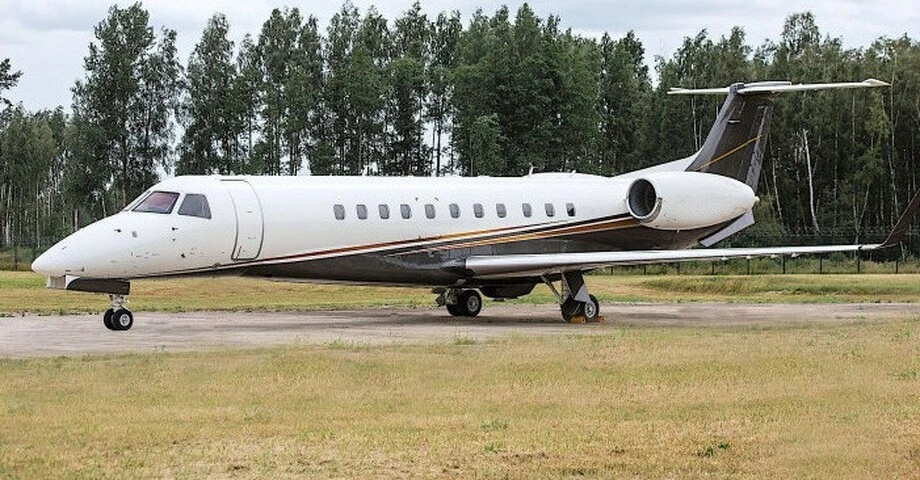
Specifications
Aircraft Details
- First delivered in 2005, with interior refurbishment in 2019.
- Powered by Rolls Royce AE3007A1E engines.
- Total engine hours: Engine 1 - 16,359 hours; Engine 2 - 16,334 hours.
- Total engine cycles: Engine 1 - 8,906 cycles; Engine 2 - 8,892 cycles.
- APU: Hamilton Sundstrand APS 500R, total hours 9,596, total cycles 11,856.
- EASA registered (formerly FAA).
- Equipped with Honeywell Primus Elite avionics, dual FMS and GPS, and dual VHF comms.
- Features ADS-B Out, TCAS 2000, and EGPWS with windshear detection.
- Interior features a 13-place configuration with a forward 4-place club, mid-cabin conference group, and aft cabin divan.
- Cabin entertainment includes two 15.1” LCD monitors and two-channel Iridium sat phone.
- Galley finished in Myrtle burl wood veneer with high gloss.
- Painted in 2019 with Chevron white, mica, and charcoal with red/gold accents.
About this Model
Overview
The Embraer Legacy 600 is a business-jet conversion of the ERJ-135 regional airliner, built around a relatively tall and wide fuselage for its class. Buyers typically consider it for missions where cabin volume, baggage accessibility, and a multi-zone layout matter as much as speed. It is commonly operated as a corporate shuttle or executive transport with a cabin that supports longer legs with more personal space than many traditional midsize platforms.
Mission Fit
The Legacy 600 tends to fit missions that benefit from a large-cabin environment: mixed seating (conference + divans), longer stage lengths, and travel with bulky luggage. It is less aligned with buyers seeking the fastest point-to-point performance or the smallest-aircraft footprint for secondary airports.
Cabin
The cabin is typically arranged in multiple zones, taking advantage of the ERJ fuselage cross-section to provide a more “large-jet” feel than many super-midsize aircraft. Most configurations support a forward galley for full-service catering, an enclosed aft lavatory, and a sizable baggage compartment that is generally accessible during flight depending on interior layout. Cabin noise and ride quality are generally oriented toward comfortable cruise rather than sport-focused performance.