

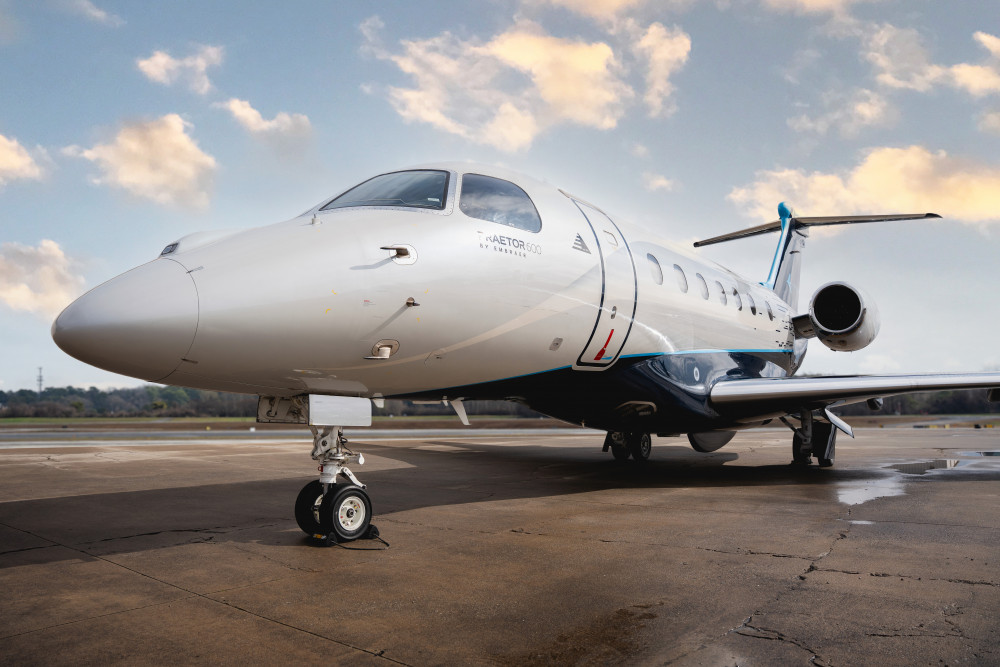
Specifications
Broker
Aircraft Details
• Former Embraer demonstrator with two U.S. owners since new
• Entry into service: 2021; based at KPDK, Atlanta, GA
• Total airframe time: 2,010 hours; 1,406 cycles
• Engines: HTF7500E on MSP Gold, 1,989 hours, 1,382 cycles each
• APU: Honeywell GTCP35-150, MSP Gold, 1,240 hours, 1,573 cycles
• Maintenance tracking: CAMP; maintained FAR Part 91
• Avionics: Collins Pro Line Fusion, FMS 4D Trajectory, RNP AR 0.3, Enhanced Vision System with HUD, triple VHF, dual HF with SELCAL, Iridium satphone, Gogo AVANCE L5 Wi-Fi, Ka-band ultra high-speed data
• Interior: 9 passengers, six captain chairs, 3-place aft divan, belted aft lavatory, new carpet (2023), stone flooring in galley/lav, extended galley with microwave, convection oven, refrigerator, espresso machine, premium cabin management, 19” HD monitors
• Additional features: Auto brake, steep approach, 115 cu. ft. oxygen cylinder, cargo fire suppression, heated baggage, main door thermo-acoustic curtain, servicing ladder, HALTO, winglets, life raft with lifeline
• Inspections: 60-month due October 2024, 12/24-month due August 2025
• Original 2019 factory paint
About this Model
Overview
The Embraer Praetor 600 sits at the upper end of the super-midsize segment, combining a large, flat-floor cabin with range that supports many North America transcontinental missions and selective transatlantic pairings. It is typically chosen by operators who want a two-pilot business jet that can cover longer stages without moving up to a heavier large-cabin platform, while still retaining access to a broad set of airports and FBO infrastructure.
Mission Fit
In day-to-day use, the Praetor 600 is oriented toward high-utilization business travel—long legs, fewer fuel stops, and consistent cabin comfort. Its range and fuel capacity give it flexibility for weather deviations and holding, but mission planning for transoceanic routes still depends on winds, alternates, payload, and regulatory requirements.
Cabin
The cabin is a flat-floor layout with a mid-cabin galley and an aft lavatory, designed for a larger-aircraft feel in a super-midsize footprint. Seating is commonly arranged for six to eight passengers with club seating forward and additional seats or a divan aft. Noise levels are generally low for the class, and the aircraft is well suited to longer legs where passengers work or rest. Baggage is typically accessible in flight, which helps on longer sectors and when carrying mixed work/personal loads.