

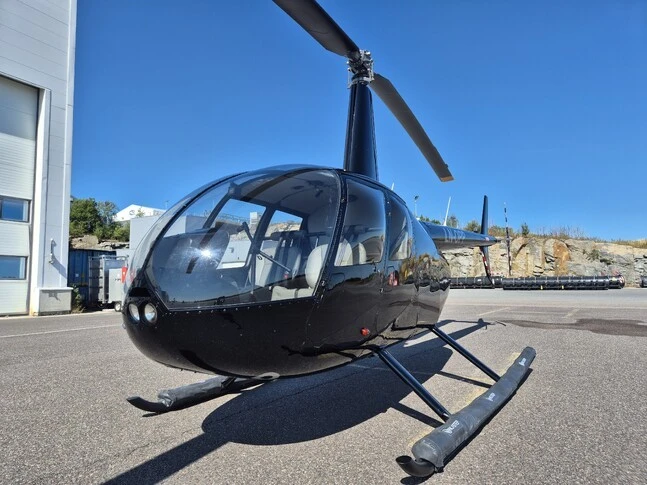
Specifications
Aircraft Details
- Major overhaul completed on airframe and engine (4400 hours).
- Freshly overhauled and fully refurbished.
- Exceptional condition, suitable for private owners, flight schools, or commercial operators.
- Upgraded avionics with 8.33 kHz channel spacing.
- Transponder with ADS-B out.
- New digital attitude and directional instruments.
- USB power outlet installed.
- Completed overhaul scheduled for August 2025.
- 2200-hour/2400-hour/12-year inspection performed.
- All life-limited components replaced with maximum service life of 2200/4400 hours/12 years.
- Airframe total time since new: 3557:00 hours.
- Engine total time since new: 3557:00 hours.
- Interior replaced with Generation Global light grey leather seat cushions with R44 engravings.
- New carpet, inner door covers, and sealing/aft wall.
- Exterior metallic black paint in excellent condition (9.5/10).
- Seven hole instrument panel.
- Bladder fuel tanks.
- Observation bubble door windows on all doors.
- Ground handling wheels included.
- Fire extinguisher and pop-out floats with new protective cover.
About this Model
Overview
The Robinson R44 Clipper II is a light, single-engine piston helicopter in the R44 family, aimed at owner-operators, flight schools, and commercial operators needing a straightforward four-seat platform. It emphasizes practical payload-and-range capability for regional trips, aerial work support, and frequent-cycle utilization, with operating economics typically associated with piston rotorcraft rather than turbine models.
Mission Fit
The Clipper II tends to fit missions where simplicity, predictable handling, and moderate trip lengths matter more than all-weather capability or turbine-class performance. Typical use cases include day VFR travel, repeated training sorties, and visual aerial work where the aircraft’s size and operating costs are central to the mission.
Cabin
The R44 cabin is a compact four-seat layout with two front seats and a rear bench. Entry is via side doors, and the cabin is oriented toward visibility and accessibility rather than executive comfort. Cabin loading is sensitive to fuel quantity and occupant weights, so real-world comfort and baggage capacity depend heavily on the planned fuel load and density altitude conditions.