

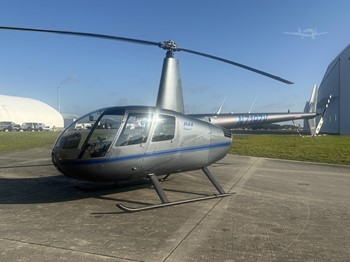
Specifications
Broker
Aircraft Details
- Factory hydraulic ship, built during transition from Astro to Raven I
- Owned by current seller for 18 years, always professionally flown, not used for training
- All airframe and landing gear/skid assemblies freshly powder coated
- New paint and high-dollar custom seats (interior redone in 2020)
- Bladder tanks and crash-resistant fuel system
- All work performed by one of RHC’s oldest and most experienced service centers
- ~1600 hours since full 2200-hour overhaul, overhaul completed 3/2024
- Approximately 10 years and ~600 flight hours remaining to next overhaul
- Aircraft available August 1st, but sale before then possible with more time remaining
- Total time: 1,600 hours
- Max takeoff weight: 2,400 lb
- Auxiliary fuel tank
- Complete logs available
- Freshly overhauled tail rotor
- Engine: Lycoming O-540-F1B5, 0 SMOH, 2200-hour TBO
- Avionics: King KY196A Comm #2, Garmin GTX335 with ADS-B, Garmin GMA340 audio panel
- Equipped with ADS-B, ELT, dual controls, and heater
- Painted in 2026
About this Model
Overview
The Robinson R44 Raven I is a light, four-seat, single-piston helicopter commonly used for primary/advanced training, local aerial work, and personal flying. It emphasizes straightforward systems, low cockpit workload for basic missions, and broad support infrastructure. Capability is best matched to short-to-medium legs with modest payload, where rapid point-to-point access matters more than high cruise speed or all-weather dispatch.
Mission Fit
The R44 Raven I fits missions where simplicity, availability of instructors/parts, and the ability to operate from small pads or confined areas are priorities. Typical use cases include regional day trips, training syllabi, and low-altitude aerial work. Missions that regularly push density-altitude limits, require significant baggage/gear, or demand IFR capability are better served by turbine or IFR-certified platforms.
Cabin
Cabin access is via four doors with a two-front/two-rear seating layout. The experience is functional and utilitarian, with limited baggage volume and a cabin environment that reflects light-helicopter realities (notably noise and vibration). Front-seat visibility is strong for training and observation; rear-seat comfort is suitable for shorter legs with adults depending on body size and installed seating.