

Specifications
Aircraft Details
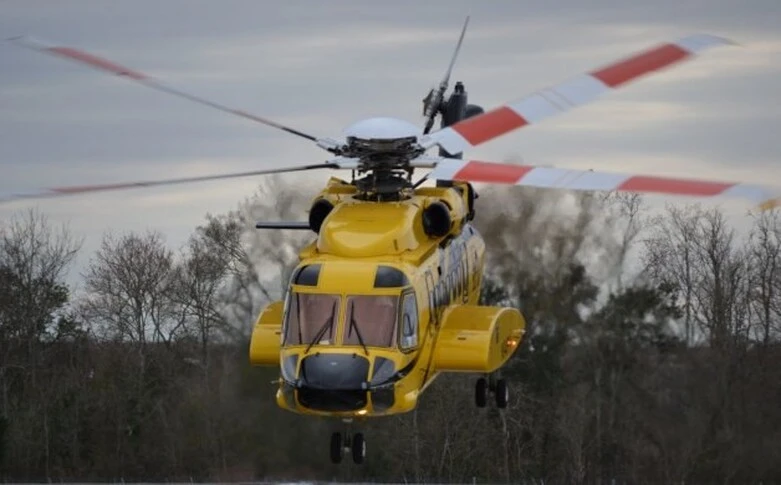
- Offshore configured helicopter
- Avionics:
- Weather Radar: Honeywell Primus 660
- Five multi-function displays
- Dual AFCS (Automatic Flight Control System)
- HUMS (Health and Usage Monitoring System)
- EGPWS (Enhanced Ground Proximity Warning System)
- VHF FM Transceiver: Technisonic TFM 550
- ADF: Collins ADF 462
- Dual NAV/VOR/LOC: Collins VIR 432
- Marker Beacon: ADELT - HR Smith CPI 503
- Dual Flight Management System: Universal UNS-I ESPW
- Dual Transponder: Collins TDR-94D, Mode S, ADS-B Out
- DME: Collins DME 442
- Dual CVR/FDR
- Dual GPS
- Radar Altimeter
- Active Vibration Control
- Dual VHF Comm: Collins VHF 422D
- TCAS (Traffic Collision Avoidance System)
- Search & Rescue Transponder: SART 3
- Satellite Communication: Iridium with IRIS DLS
- Dual SSQAR
- Interior:
- Nineteen passenger seats
- Lonplate II floor covering
- Soundproofing
- Cargo restraint net
- Kydex baggage storage
- Additional Equipment:
- 15 AH battery
- Two first aid kits
- Pulse light system
- Two life rafts
- Engine drain collection tank
- Push-out windows
- Cockpit air deflectors
- Engine wash system
- Two portable fire extinguishers
- Heels flotation system
- Air conditioning
- Cabin audio handset
- Fuel filler guard
- Door scuff guard
About this Model
Overview
The Sikorsky S-92 is a multi-role, twin-engine helicopter commonly configured for offshore energy transport, search-and-rescue, government/VIP movement, and utility support. It is positioned around high payload capability, long overwater legs, and an aircraft-style approach to redundancy and mission equipment integration. Buyers typically evaluate the S-92 as a platform where mission fit is defined by cabin capacity, hoist/EMS/utility options, and dispatch reliability expectations rather than cruise speed alone.
Mission Fit
In typical configurations, the S-92 fits missions that need a sizeable cabin, meaningful payload margin, and all-weather IFR operations. It is particularly aligned with overwater operations and role-based equipment (life rafts, floats, hoist, mission consoles). If most flying is short-range point-to-point with limited passengers, the aircraft’s scale, crew requirements, and support footprint may be more than needed.
Cabin
The cabin is designed to be configured around the mission—most commonly higher-density passenger transport for offshore work, or lower-density layouts for VIP/government with additional storage and amenities. Large doors and a flat-floor style cabin support rapid reconfiguration for seats, stretchers, or mission equipment. Noise and vibration outcomes depend heavily on interior package, seat track layout, and operator-installed soundproofing standards.