

Specifications
Broker
Aircraft Details
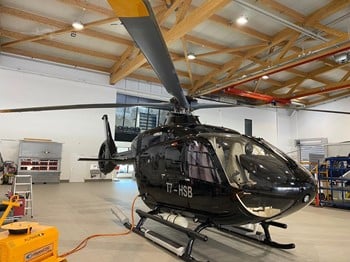
- Model: H135T3
- Condition: Used
- Additional equipment and avionics:
- First aid kit
- Engine fire extinguishing system
- Fuzz Burners
- Engine cowling heat protection
- Engine compressor wash kit
- Flashlight for copilot side
- Windshield wiper system
- Center console and avionics compartment
- Copilot flight controls (detachable parts)
- Instrument panel extension on copilot side
- Map cases in copilot door and instrument panel glare shield
- Bleed air heating system
- 40 Ah, 24 VDC battery (ULM Saft)
- Rotor brake system
- Emergency Locator Transmitter (ELT)
- Digital Audio Control System (DACS)
- Garmin GTX 335R transponder
- Garmin GTN 750 GPS/NAV/COM (pilot and copilot)
- Radar altimeter KRA405B (Honeywell)
- Helicopter Terrain Awareness Warning System (HTAWS) - Helionix
- Synthetic Vision System (SVS) - Helionix
- 4-axis Automatic Flight Control System
- Air Conditioning System (ACS)
- Emergency floats (fixed provisions)
- Enhanced sound proofing
- Wireless connectivity Flight Stream 510 (Garmin)
- Cockpit Voice and Flight Data Recorder (CVFDR) (fixed and detachable parts)
About this Model
Overview
The Airbus H135 is a light, twin-engine helicopter commonly selected for missions that need a small landing footprint, rapid start/stop cycles, and strong dispatch reliability. It is widely used in HEMS, law enforcement, offshore support, and corporate/utility flying where a twin-engine platform and modern avionics are preferred over maximum cabin volume. The design emphasizes accessibility, visibility, and configurable interiors rather than long-range cruise efficiency.
Mission Fit
The H135 tends to fit operators who fly many short sectors, operate from constrained pads, and value multi-role reconfiguration. It can be equipped for IFR and night operations, making it suitable for time-critical dispatch profiles. Buyers prioritizing maximum passenger comfort, baggage volume, or sustained high-speed cruise for longer legs often move up to larger helicopter classes.
Cabin
Cabin experience is mission-dependent because the H135 is frequently delivered with purpose-built interiors (medical, law enforcement, utility, or corporate). The airframe’s compact cross-section supports efficient seating and equipment layouts, with an emphasis on access and workflow rather than stand-up room. For passenger configurations, seating is typically arranged to balance capacity with cabin access, and noise/vibration outcomes depend on specific build standard, interior treatment, and installed equipment.