

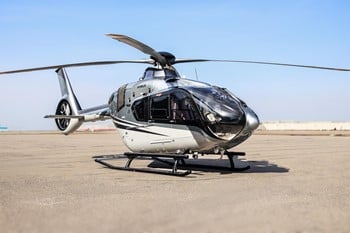
Specifications
Broker
Aircraft Details
• Located in Mont-Royal, Quebec, Canada
• Used condition, airworthy status
• Total airframe time: 319.4 hours
• IFR flight rules
• Avionics package: DP IFR GTN 750Xi/GTX 335R, digital audio control system (DACS), ADS-B Out, Iridium satellite transceiver (GSR 56), wireless connectivity (Flight Stream 510), color weather radar (Honeywell RDR 2000), traffic advisory system (Avidyne TAS620A), moving map (Helionix), cockpit voice and flight data recorder (CVFDR)
• Enhanced soundproofing kit
• Dual controls, air conditioning, heater, baggage compartment
• Corporate interior configuration, 6 seats
• Year painted: 2023, hinged and sliding doors
• Cabin features: leather upholstery, carpeted cabin/cockpit/cargo, rear cabinet with USB power sockets, metal placards, separation wall for cabin/cargo, retractable coat hooks, map cases, one-hand latching system for clam-shell doors, alternate gross weight 3,100kg
About this Model
Overview
The Airbus H135 is a light, twin-engine helicopter commonly selected for missions that need a small landing footprint, rapid start/stop cycles, and strong dispatch reliability. It is widely used in HEMS, law enforcement, offshore support, and corporate/utility flying where a twin-engine platform and modern avionics are preferred over maximum cabin volume. The design emphasizes accessibility, visibility, and configurable interiors rather than long-range cruise efficiency.
Mission Fit
The H135 tends to fit operators who fly many short sectors, operate from constrained pads, and value multi-role reconfiguration. It can be equipped for IFR and night operations, making it suitable for time-critical dispatch profiles. Buyers prioritizing maximum passenger comfort, baggage volume, or sustained high-speed cruise for longer legs often move up to larger helicopter classes.
Cabin
Cabin experience is mission-dependent because the H135 is frequently delivered with purpose-built interiors (medical, law enforcement, utility, or corporate). The airframe’s compact cross-section supports efficient seating and equipment layouts, with an emphasis on access and workflow rather than stand-up room. For passenger configurations, seating is typically arranged to balance capacity with cabin access, and noise/vibration outcomes depend on specific build standard, interior treatment, and installed equipment.