

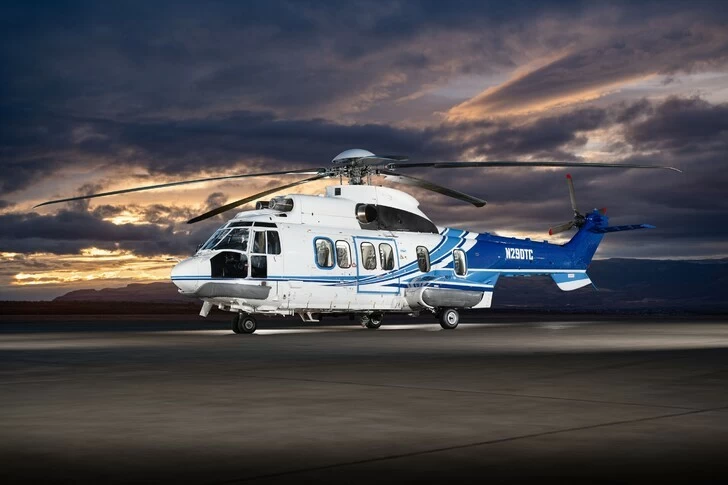
Specifications
Broker
Aircraft Details
- Offshore configured
- Very low time
- Emergency floats
- Cargo sling & hoist
- Engines: Safran Makila 2A1
- Engine #1 TSN: 3,982.20 hrs
- Engine #2 TSN: 5,279.19 hrs
- Avionics: Collins Proline 21 suite
- VHF, DME, VOR/ILS/MKR/ADF
- NAT DACS ICS with multiple control panels
- Collins TDR94D Mode S transponder
- Weather radar: Telephonics RDR 1600
- EGPWS Honeywell MKXXLL
- TCAS II: Collins TTR 4000
- FMS CMA9000
- SATCOM: Skytrack ISAT200R
- Interior: 19 passenger crashworthy seats
- Comfort upholstery with soundproofing
- Air conditioning (cabin & cockpit powered)
- Pressure refueling installation
- Auxiliary fuel tanks
- Emergency flotation gear with automatic firing kit
- Life rafts for 18 to 27 passengers in multipurpose sponsons
- Additional safety equipment compliant with JAR OPS 3
About this Model
Overview
The Airbus H225 (formerly Eurocopter EC225) is a heavy-class, twin-turboshaft helicopter designed around high payload, long overwater legs, and all-weather dispatch expectations typical of offshore energy, government SAR, and large-utility operations. Buyers typically evaluate it for missions that need a spacious cabin, strong external-load capability, and redundant systems for IFR and demanding environments, rather than for low-intensity short-hop charter work.
Mission Fit
In service, the H225 is most often selected when the mission is driven by payload and overwater range—moving people and equipment to remote sites, sustaining SAR coverage, or carrying specialist mission kits (medical, EO/IR, communications, de-icing/icing provisions where equipped). It is less compelling when missions are short-range, lightly loaded, or require minimal footprint.
Cabin
The H225’s cabin is sized for multi-row seating and mission equipment, with a flat-floor, walk-through interior typical of heavy twins used in offshore and public-service work. Operators can configure high-density transport layouts or more missionized interiors (medevac, SAR consoles, workstations). Noise and vibration levels depend strongly on interior kit, insulation, and mission equipment installed; buyers should review the exact cabin fit and certification basis of the aircraft being considered.