

Specifications
Aircraft Details
- One corporate owner since new
- Oceanic package
- Flight Data Recorder (FDR) equipped
- Dual aft jump seats
- Digital pressurization system
- IS&S auto throttles
- Engines enrolled on ESP
- ProParts maintenance program
- Various warranties active
- Avionics: Collins Pro Line Fusion suite
- Dual Collins ADC-3000 air data computers
- Dual Collins AHC-3000 attitude heading system
- Dual Collins FGC-3000 flight guidance computers
- Dual Collins VHF-4000 communication radios
- L3 FA2100 cockpit voice recorder (120 minutes)
- Collins DME-4000 distance measuring equipment
- Collins AFD-3700 electronic flight instrumentation system
- Dual integrated Collins FMS and GPS-4000S
- Collins NAV-4500 navigation radios
- Collins ALT-4000 radar altimeter
- Collins TCAS-4100 traffic collision avoidance system
- Dual Collins TDR-94D transponders
- Spacious cabin accommodating up to 11 passengers and 2 pilots
- Interior features black leather, dark woodwork, and executive writing tables
- Aft zone includes a side-facing belted electric-flushing lavatory seat
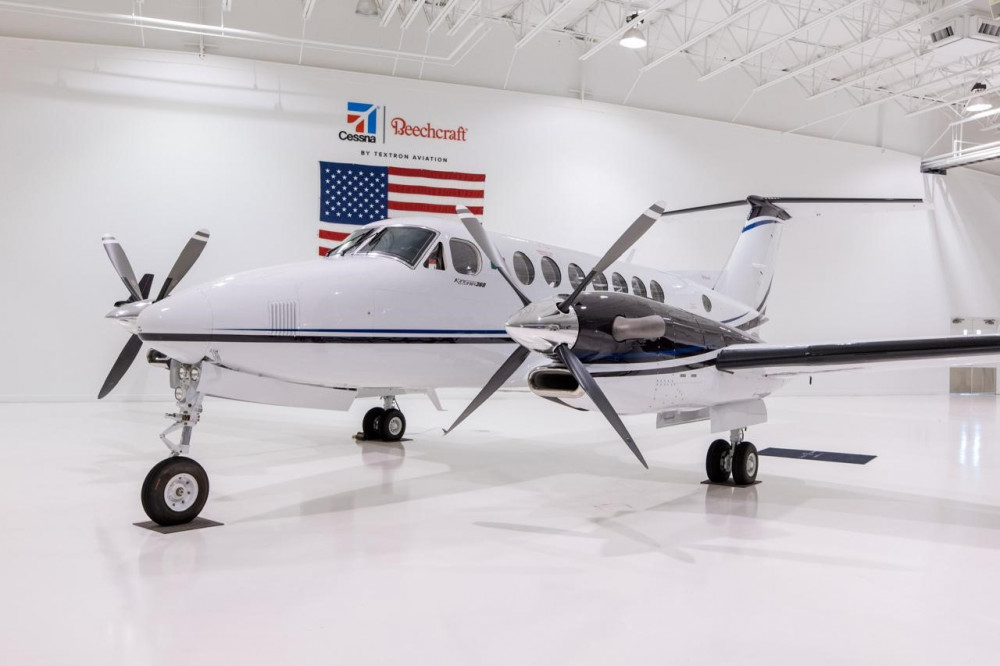
- Exterior painted in Matterhorn white with Axalta charcoal gray and royal blue stripes
- Equipped with winglets and LED lighting
About this Model
Overview
The King Air 360 is a pressurized, twin‑engine turboprop built around the King Air operating concept: access to shorter runways, robust performance in mixed weather, and efficient regional stage lengths. Compared with earlier King Air generations, the 360 emphasizes updated avionics, cabin refinement, and cockpit automation while retaining the type’s utility for corporate shuttle, owner-operator travel, and special-mission roles.
Mission Fit
Most buyers use the 360 for 300–800 nm legs where its cruise efficiency, rapid climb, and ability to use shorter runways can reduce total trip time versus driving to major hubs. It is also a fit for routes with seasonal weather where certified deicing capability and turboprop responsiveness are valued. If your flying is consistently long-range or you prioritize a larger, quieter cabin at high jet altitudes, a jet platform may align better.
Cabin
The cabin is arranged for business travel with club seating options and a practical balance of passenger comfort and baggage capability. Expect a pressurized environment suitable for typical turboprop cruise altitudes, with noise and vibration generally higher than comparable jets but improved by modern interior treatments. Storage and access are oriented toward real-world trips—carry-on items, coats, and work materials—rather than purely lounge-style space.