

Specifications
Aircraft Details
- Maintenance: Maintained under FAR Part 91, ProParts airframe maintenance program, CESCOM tracking, RVSM certified.
- Engines: Two FJ44-3A engines, TAP - Elite maintenance program, TBO of 4000 hours, both engines with 1115 hours since new and 703 cycles.
- Avionics:
- Dual Collins AHC-3000 AHRS
- Collins FGC-3000 IFCS autopilot and flight director
- Collins Pro Line 21 avionics package
- Dual Collins VHF-4000 communication radios
- L3 FA2100 CVR
- Collins DME-4000
- Collins 3-tube 8x10-inch EFIS
- Collins FMS-3000
- Dual Collins NAV-4500 navigation radios
- Collins ALT-4000 radar altimeter
- AirCell ST-3100 Iridium SATCOM
- L3 LandMark TAWS-8000 EGPWS
- L3 Skywatch HP TCAS-I
- Dual Collins TDR-94 Mode S transponder
- Collins WXR-800 weather radar
- Interior: Executive configuration for 8 passengers, beige Sienna leather seating, tan Ultraleather headliner, Kalogridis mink carpeting, forward refreshment center, gloss Montana walnut laminate cabinetry, AvVisor 8.4-inch display for entertainment, belted flushing aft lavatory.
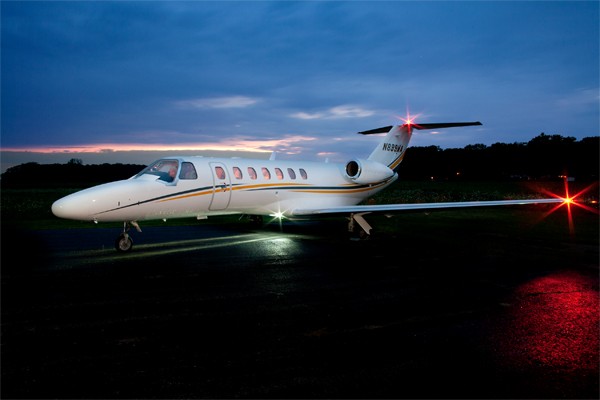
- Exterior: Snow white with blue-gray, yellow, and Nordic gray colors.
About this Model
Overview
The Citation CJ3 sits in the light-jet segment as a step-up from entry-level light jets, focusing on predictable day-to-day dispatch, access to a broad set of runways, and a cabin sized for typical 4–6 passenger business trips. It is commonly used for regional and multi-stop schedules where turn time, straightforward avionics, and manageable operating complexity matter as much as cruise capability.
Mission Fit
A CJ3 is most at home on short-to-midrange stage lengths, including out-and-back days and multi-stop itineraries. It can support longer legs depending on payload, winds, and reserves, but the most consistent use case is efficient regional coverage rather than routine transcontinental flying at higher passenger counts.
Cabin
The CJ3 cabin is arranged around a center aisle with opposing club seating in the main cabin and an enclosed aft lavatory. The cabin height and width are typical for the light-jet class, with a step-down or slight floor contouring depending on interior generation and refurbishment. Noise levels, ride comfort, and environmental control are generally aligned with modern light jets; perceived comfort depends heavily on interior condition, seat design, and maintenance of seals and environmental systems.