

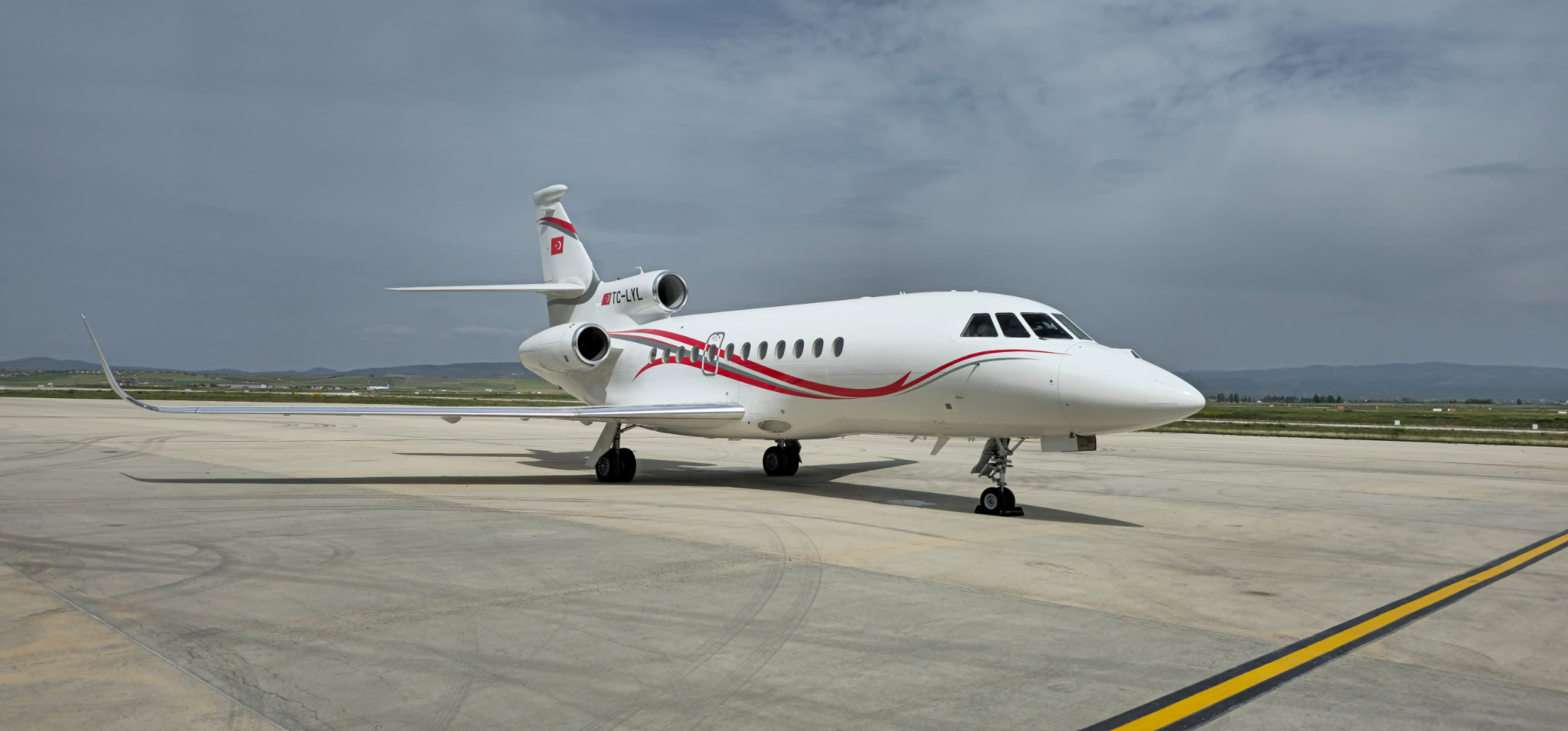
Specifications
Broker
Jet Aviation Brokers
John Carter
broker@example.com
Aircraft Details
- Model: DASSAULT FALCON 900LX
- Condition: Used, great condition, hangared, used only by the owner
- Maintenance: Fresh 2C inspection, MPI, landing gear overhaul
- Engines: Honeywell TFE731-60-1C, enrolled on Honeywell MSP Gold
- Engine 1: 3,845 hours, 1,856 cycles
- Engine 2: 3,845 hours, 1,856 cycles
- Engine 3: 3,869 hours, 1,864 cycles
- APU: Honeywell GTCP36-150F, 2,443 hours, enrolled on MSP Gold
- Avionics:
- ADS-B Out, CPDLC, FANS 1/A, Synthetic Vision System (SVS)
- Dual Honeywell communication systems, GPS, and navigation radios
- Interior:
- Seating for 14, beige leather seats with brown inserts, galley with central water system, Nespresso coffee maker, and high-temperature oven
- Lavatory configuration: Forward and aft
- Exterior: Overall white with red and grey curved stripes
- Additional Equipment: Rockwell Collins HD entertainment system, Wi-Fi, dual 12-person life rafts, enlarged oxygen bottle, telescopic tow bar
- Inspection Status: Fresh 12-month and 800-hour inspections due April 2026
About this Model
Overview
The Falcon 900LX is a long-range derivative of the Falcon 900 family, combining a three-engine layout with winglet-equipped aerodynamics to support intercontinental missions while retaining strong short-field and hot/high capability. It is commonly selected by operators who want large-cabin comfort with access to more restrictive runways than many comparable long-range business jets.
Mission Fit
It fits missions where a true large-cabin aircraft is needed but the airport network includes shorter or more performance-limited fields. The range profile supports nonstop city pairs across the North Atlantic and deep transcontinental segments with typical business-jet reserves, while still being comfortable for shorter regional legs.
Cabin
The cabin is a true large-cabin cross-section with a typical three-zone layout, allowing a mix of club seating, conference or dining space, and an aft lounge or additional seating depending on configuration. A forward galley and multiple lavatory options are common, supporting international service routines and longer stage lengths. Noise levels and ride quality are generally well managed for long-duration flying, and baggage volume is suited to extended trips for a full passenger load.